
The best software for hospital management covers OPD, IPD, billing, pharmacy, lab and EMR in one system. It should also run reliably in your wards and meet NABH and ABDM requirements. If you want a full cloud system, MocDoc, eMedHub, CognitiSoft and Softcure are the options to demo. If you already run a HIS and still keep paper IPD files, PurpleIPD is the layer to add.
Most hospitals in Ahmedabad, Vadodara, Surat, Rajkot and Gandhinagar choose from a brochure and a scripted demo. Months later they find that pharmacy was a separate quote, or that nurses still write on paper because the screens do not match their forms. A hospital management system only pays off when your staff actually use it at the bedside.
This list compares five options on what each covers, who it suits and what to confirm before you sign. We are PurpleBits Infosystems in Vadodara, the makers of PurpleIPD, so we list it first and say plainly where it stops. Verify module lists for every vendor in a live demo.
1. PurpleIPD for paperless IPD documentation
PurpleIPD replaces paper IPD files with tablet-based forms and runs alongside your existing HIMS. It is not a full hospital management system, and it does not replace your billing or pharmacy module.

What it covers
Staff write with a stylus on scanned copies of your current forms, or on forms made in the built-in form builder. PurpleIPD connects with your HIMS, lab systems, billing software, and with ABDM and HCX. Its main features are:
- A real-time audit trail of every change, login and access
- Video consent recording, with PM-JAY consent built in
- Automatic flags for missing or incomplete forms
- Integrated OPD and IPD documentation, digital prescriptions and lab report management
- AI-generated discharge summaries from data entered during the stay
Paperless IPD works when it copies the forms your staff already use, not when it forces new ones.
Who it suits
It suits private and mid-sized hospitals with inpatient wards that already run a HIS but still keep paper case sheets. New hospitals that want to be paperless from day one also fit.
Savings depend on your volume. Hospitals report up to a 70% cut in stationery costs, so if you spend ₹10 lakh a year on printing and files, that is up to ₹7 lakh back. VIMS Hospital shortened discharge turnaround by 1.5 hours.
What to confirm before you buy
Ask for a quote based on tablets or beds, since PurpleIPD is priced either way. Onboarding takes 6 to 8 weeks, and the team configures your paper forms for you.
- Hardware: standard Android tablets, including Samsung or Lenovo tablets with a stylus
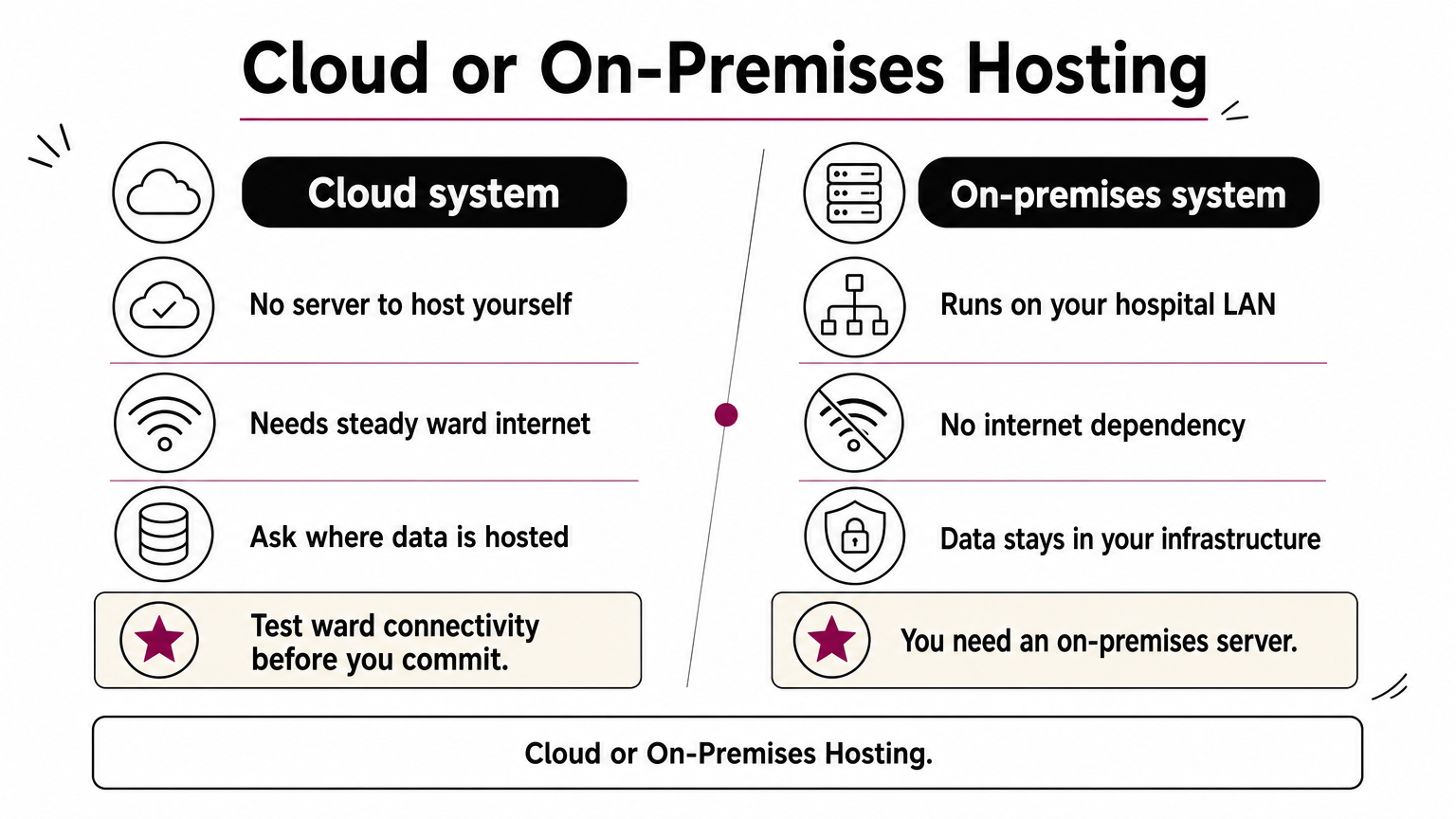
- Hosting: runs on your hospital LAN with no internet dependency, so you need an on-premises server
- Data: stays inside your own infrastructure for DPDP, encrypted, with cloud backup
2. MocDoc for cloud-based hospital and lab management
MocDoc is a cloud-based hospital and lab management system that gives hospitals one browser-based platform for patient flow, pharmacy and diagnostics. It is the closest match here if you would rather not host anything yourself.
What it covers
MocDoc handles OPD, IPD, pharmacy and lab in one system, with extras aimed at patient convenience:
- EMR/EHR
- OP and IP flow
- Pharmacy
- Lab tests
- Patient portal
- Teleconsultation
Who it suits
Pick it if your hospital runs an in-house lab and you want teleconsultation and a patient portal without separate tools.
Weigh it carefully if your wards have patchy internet, because any cloud system depends on connectivity. Test that before you commit.
A cloud system is only as dependable as the connection in your wards.
What to confirm before you buy
Ask for a demo with your own workflow, from registration to discharge and billing, not a scripted tour. Then check three things:
- Where patient data is hosted and how it is backed up
- Whether ABDM and NABH support is live or only planned
- How the system behaves when your internet drops
3. eMedHub for ABDM-verified HIMS and EHR
eMedHub is a cloud-based HIMS and EHR that leads with compliance. It lists itself as ABDM-verified and NABH-ready with more than 23 modules, and its public page targets hospitals and clinics in Gandhinagar.
What it covers
With 23+ modules spanning hospital operations and electronic records, the real question is which ones you need on day one and which are optional extras.
Its compliance positioning matters if you plan NABH accreditation or want ABHA record linking, since both shape how you document care.
A long module list helps only if the modules you need are in your quote.
Who it suits
It suits Gandhinagar and nearby hospitals that want a compliance-first system and expect to grow into more modules.
It also suits clinics moving up to a hospital setup. They get room to grow without switching vendors.
What to confirm before you buy
Ask the vendor to show its ABDM verification rather than just quote it. Then check:
- Which modules sit in the base price
- How long migration of your old patient records takes
- Who trains your reception, nursing and billing staff
4. CognitiSoft for Ahmedabad hospitals
CognitiSoft sells a secure, cloud-based HMS that packs the core stack into one product. It markets directly to Ahmedabad hospitals.
What it covers
Its listing names six core modules, the same set most buyers start with:
- OPD
- IPD
- Billing
- Pharmacy
- Lab
- EMR
Who it suits
Choose it if you run a hospital or clinic in Ahmedabad and want the standard six modules from a vendor that markets to your city.
Local presence matters when something breaks during a night shift. Ask about on-site support and response times in writing.
Local support is worth more than a longer feature list when a billing counter stops at night.
What to confirm before you buy
Ask how far the system can be customized to your forms and billing rules. Many hospitals discover their package or tariff structure does not fit a template. Check:
- Whether your existing rate cards can be loaded as they are
- What reports the management team gets without extra development
- How data is exported if you ever switch systems
5. Softcure for diagnostics-heavy hospitals
Softcure offers hospital and clinic software with unusually wide diagnostic coverage. Pathology, radiology and sonography sit alongside OPD, IPD, EMR and billing, and it also lists accounting and TPA handling.
What it covers
Softcure lists these areas, so it suits hospitals that treat diagnostics as a revenue line:
- E-prescription
- OPD and IPD
- EMR
- Billing
- Pathology, radiology and sonography
- Accounting and TPA
Who it suits
It fits hospitals and polyclinics with in-house imaging and sonography units that need report workflows in the same system as billing.
It also fits hospitals with a high share of insurance and TPA patients, where claim paperwork consumes billing staff time.
If diagnostics and insurance drive your revenue, test those two workflows before any others.
What to confirm before you buy
Ask for a demo that follows one TPA patient from admission to final bill. Then check:
- How claim documents are compiled and who reviews them
- How radiology reports and images are stored and retrieved
- Whether accounting data exports cleanly to your accountant’s software
How to shortlist and decide
Start with a short list of your required modules: OPD, IPD, billing, pharmacy, lab and EMR. Decide whether you want cloud hosting or data on your own premises. Then run each demo with your own forms, tariffs and one real discharge. A hospital management system that works on your paperwork will work on your wards.
The four full systems here differ in hosting, compliance positioning and diagnostic depth. None of them removes the paper from inpatient files unless your nurses and doctors actually document in it at the bedside. That is the gap PurpleIPD fills on top of a HIS.
If your HIMS is in place and your IPD files are still paper, book a PurpleIPD demo and see your own forms on a tablet.
