
A medical records department in hospital (MRD, also called the health information department) is the unit that creates, stores, protects, retrieves and analyzes every patient’s clinical file. That covers everything from the registration slip to the discharge summary. It is the custodian of the hospital’s legal and clinical memory, and it answers to doctors, auditors, insurers and patients alike.
In Indian hospitals the department carries extra weight. NABH assessors inspect its files, TPAs ask it for documents before settling claims, and courts summon its records in disputes. When a file goes missing, the MRD head is usually the first person asked.
This article explains why the department matters, how a record moves through it, what its core responsibilities are, and how it is staffed and housed. PurpleIPD builds paperless IPD software for Indian hospitals, so the last section also covers what changes when the records room goes digital.
Why the medical records department matters
The department matters because every clinical, legal and financial decision in a hospital depends on a complete patient file that someone can find in minutes. When it works well, nobody notices. When it fails, treatment slows down, claims stall and audits turn painful.
Continuity of care
A doctor on night duty needs the previous discharge summary, the allergy history and the last set of lab values. If the file is in the wrong ward or was never filed, decisions get made without the patient’s history. The MRD makes sure the file reaches the right ward quickly and that every sheet inside it belongs to the right patient.

Legal, accreditation and insurance value
The file is the hospital’s main defence in a consumer or medico-legal case, so completeness and legibility protect the hospital as much as the patient. NABH standards expect a defined record format, unique patient identification, confidentiality controls, a retention policy and periodic record audits. Insurers and TPAs also reject or delay claims when documents are missing, which makes the department a direct link to hospital revenue.
A hospital can only defend, bill and treat what its records can prove.
How a patient record moves through the department
A record moves through seven steps, from registration to retention or destruction, and each step needs a named owner. Writing these steps into a standard operating procedure (SOP) is the single most useful thing a hospital can do for its records room.
The seven steps from admission to archive
The sequence below applies to inpatient files. Outpatient records follow a shorter version of the same path.
- Registration: the patient gets a unique hospital ID (UHID), and the admission file is opened under that number.
- Assembly: the admission form, consent forms, case sheet and nursing charts are put together at the ward.
- Active use: during the stay the file stays at the ward, and every entry is dated, timed and signed.
- Discharge check: the MRD reviews the file for missing forms, unsigned entries and an absent discharge summary, then sends deficiencies back to the doctor or nurse.
- Coding and indexing: diagnoses and procedures are coded, commonly with ICD-10, and entered in the disease and procedure indexes.
- Filing: the file is stored in a fixed order, with a sign-out system for every file that leaves the room.
- Retention and disposal: the file is kept for the period set by law and hospital policy, then destroyed under written authorization.
Controls that keep the process safe
Three controls matter most. First, only authorized staff may take a file out, and each movement is logged. Second, release of information needs a written request, proof of identity and consent from the patient or a legal authority. The 2002 Medical Council of India professional conduct regulations expect a hospital to acknowledge such a request and issue the records within 72 hours.
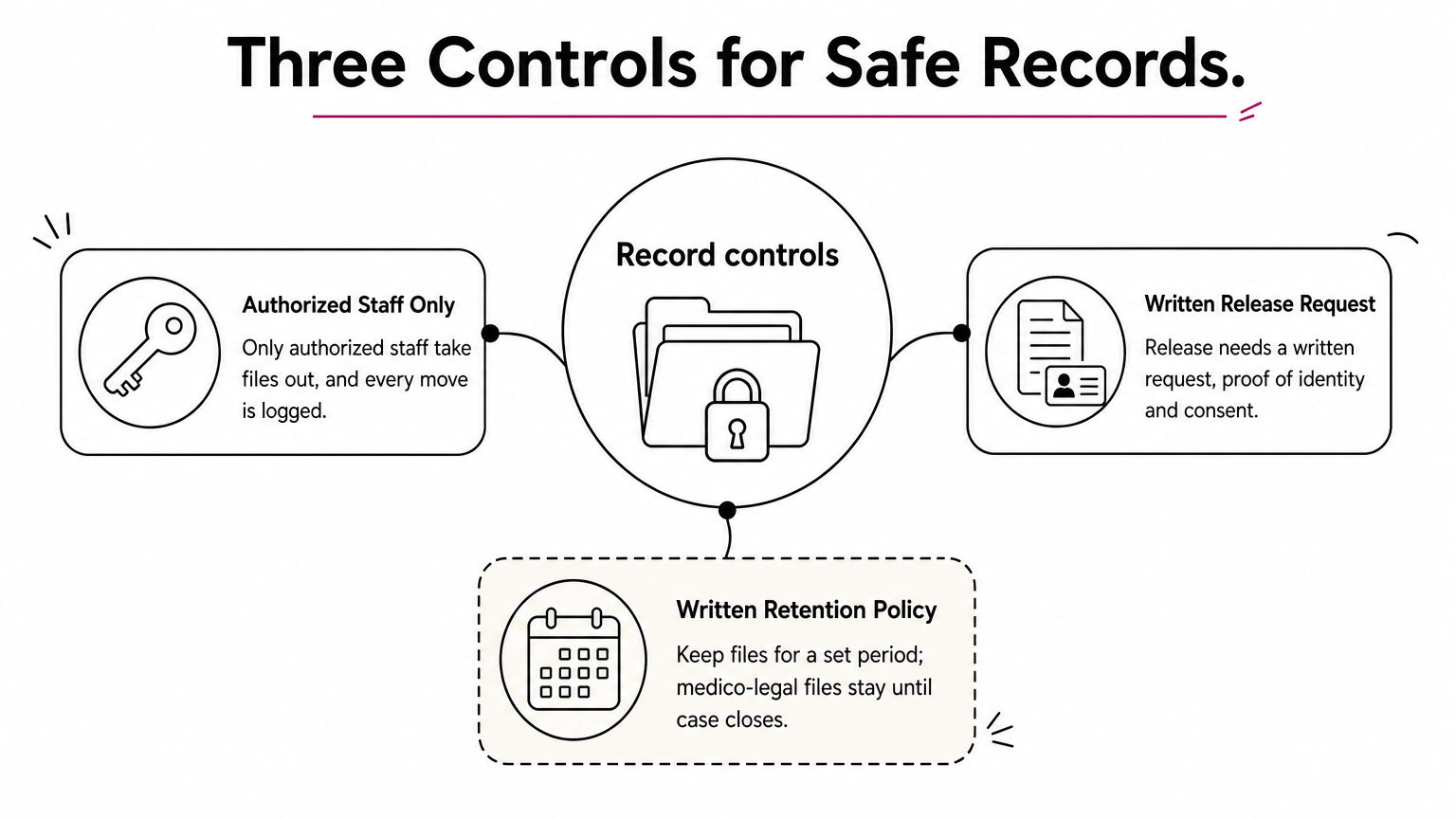
Third, retention must be a written policy. The same regulations require indoor patient records to be kept for at least three years, and many hospitals keep them longer. Files tied to a medico-legal case should stay until the case closes. Check your state rules and your NABH retention policy before you set the number.
A record is only reliable if every step, from opening to disposal, has an owner and a log.
Core functions and responsibilities of the department
The department has six core responsibilities: registration, custody, completeness audit, coding, statistics and controlled release of information. The table shows who relies on each one.
The six responsibilities at a glance
| Function | What it covers | Who relies on it |
|---|---|---|
| Registration and identification | Issues UHID, opens and links files | Front desk, wards |
| Custody and retrieval | Stores, tracks and issues files | Doctors, nurses |
| Completeness audit | Checks forms, signatures, discharge summary | Quality team, NABH assessors |
| Coding and indexing | Assigns ICD-10 codes, keeps disease index | Billing, insurers, researchers |
| Statistics | Census, occupancy, length of stay, mortality | Administration, management |
| Release and confidentiality | Handles patient, TPA and court requests | Patients, insurers, courts |
What the statistics function delivers
Many people overlook the statistics function, yet management reports come from it. Take a 100-bed hospital over 30 days. It has 3,000 available bed days. If patients occupied 2,250 of them, bed occupancy is 2,250 ÷ 3,000 = 75%. With 450 discharges in the same month, average length of stay is 2,250 ÷ 450 = 5 days.
These two figures tell the administrator whether beds are scarce or idle. They are only as accurate as the discharge dates and diagnoses in the files, which is why the completeness audit comes first.
Good statistics start with complete files, because every report is built from them.
How the department is organized and housed
The department is usually headed by a medical records officer who reports to the medical superintendent or the quality head. Its layout, shelving and access rules matter as much as its staffing.
Sections and staff
Larger hospitals split the work into registration, filing and retrieval, coding and indexing, statistics, and release of information. In a small hospital, one or two trained record staff cover several of these roles. The officer owns the SOP, trains ward staff on documentation rules and presents record audit results to the quality committee.
Coders need training in ICD classification, and filing staff need discipline more than anything else. A misfiled sheet is nearly as costly as a lost file.
Space and storage conditions
Place the records room where wards and the OPD can reach it quickly, with restricted entry and a single sign-in point. Closed shelving, fire protection and protection from damp and pests are basic requirements. Many hospitals file by terminal digit, which means ordering files by the last digits of the record number. This spreads daily filing evenly across the shelves and reduces misfiles.

The records room is a controlled area, and its access log is part of the record.
How paperless IPD changes the department’s work
Paperless IPD moves the active inpatient record from paper to tablets, so the department spends less time hunting for files and more time auditing quality. The duties stay the same. The tools change.
What paper costs the department
Paper files need printing, shelf space, staff to pull and refile them, and time at every discharge to chase missing sheets. Many Indian hospitals spend lakhs each year on stationery, and then again on running the records room. Retrieval during an audit or a claim query is slow, and a sheet written in a ward can be lost before it ever reaches the MRD.
How a digital layer fits in
PurpleIPD is an inpatient documentation layer that sits alongside your existing HIS or HIMS, not in place of it. Staff write with a stylus on your hospital’s own forms, digitized by the PurpleIPD team, or on custom forms from its form builder. It runs on standard Android tablets such as Samsung or Lenovo, and implementation typically takes 6 to 8 weeks. For the MRD, these features matter most:
- Compliance flags highlight missing or incomplete forms before discharge, so staff can fix them right away and reduce the time taken to discharge a patient.
- A real-time audit trail records every change, login and access, which supports NABH and medico-legal review.
- Role-based access limits who can view or edit a record.
- Video consent and media attachments sit inside the patient file.
- On-premises storage keeps patient data inside the hospital’s own infrastructure.
Hospitals using PurpleIPD report up to a 70% reduction in stationery costs. Old paper files still need a retention plan, so digitizing historical records is a separate step to schedule.
Going paperless does not remove the records department’s duties, it removes the paper that slows them down.
Building a records room that works
A medical records department in hospital settings does one job: it makes sure the right record exists, is complete, is safe and can be found when someone needs it. Write down the workflow, name an owner for each step, audit files at discharge and set a clear retention policy. These four habits solve most records problems.
If your team still loses time chasing paper at discharge and during audits, a digital documentation layer is the next step. You can see how PurpleIPD takes paper out of inpatient records and judge how it would fit your own forms and wards.
