
The best software for electronic medical records in Gujarat depends on what you run: a clinic, a private hospital or a government facility. PurpleIPD suits private hospitals that want paperless inpatient documentation on top of an existing HIS. SoftClinic GenX suits hospitals and clinics that want one suite from an Ahmedabad vendor. Doctors App suits doctors who want AI-assisted notes. Doxxy suits small outpatient clinics. eHospital suits government institutions.
Most buyers hit the same wall. Every vendor page calls itself the best, and few say what the software does not cover. Paper case sheets, misplaced files and slow discharges are not fixed by an ABDM badge on a website. This article gives you five options, what each one covers, who it fits and what to check in a demo, then shows you how to compare them side by side.
One disclosure first. PurpleIPD is made by PurpleBits Infosystems in Vadodara, and we list it first. It is an inpatient documentation layer, not an outpatient clinic EMR, and we say plainly where it fits and where it does not. Details on the other vendors come from their published descriptions, so confirm every point in a live demo.
1. PurpleIPD
PurpleIPD is paperless IPD software for Indian hospitals. It replaces paper case sheets, IPD files and registers with tablet-based digital forms. It is built by PurpleBits Infosystems in Vadodara and sits next to your HIS instead of replacing it.
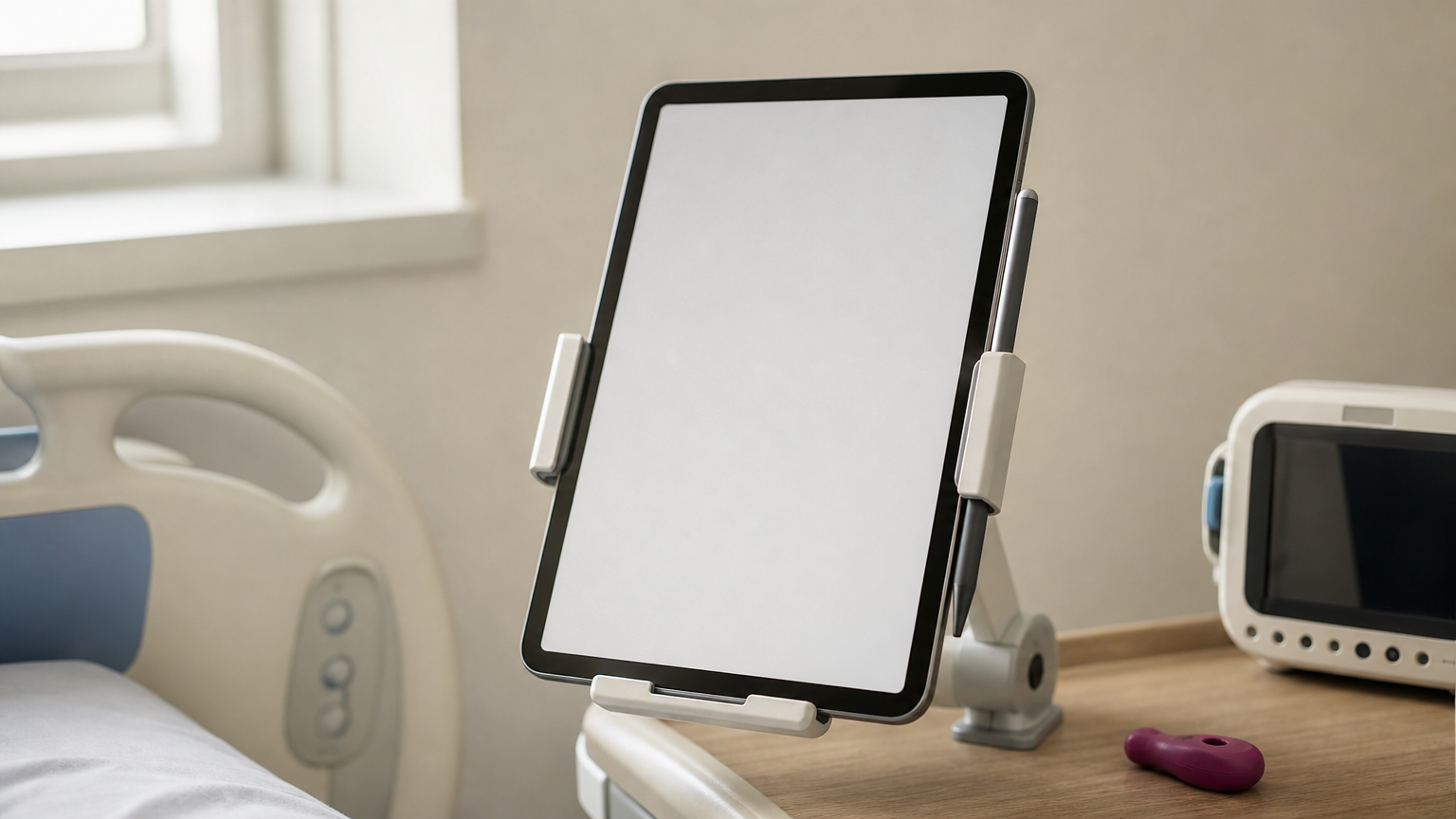
Many inpatient wards do not lack a full EMR, they lack a digital case sheet that nurses and doctors will actually fill in.
What it covers
Staff write with a stylus on scanned versions of your existing paper forms, or on custom forms made in the form builder. Data is entered during the round, not after it, and several departments can work on the same record at once. It runs on standard Android tablets (Samsung or Lenovo with stylus) and on your hospital LAN, so it has zero internet dependency.
- Real-time audit trail of every change, login and access
- Video consent recording, including PM-JAY video consent
- Compliance flags that show missing forms before discharge
- Integrated OPD and IPD documentation, digital prescriptions and lab report management
- Role-based access, encryption and cloud backup
- AI discharge summaries built from data entered during the stay
- Connections to ABDM and HCX, plus compatibility with your HIMS, lab and billing systems
Who it suits
PurpleIPD fits private and mid-sized multi-specialty hospitals with inpatient wards that have NABH accreditation or are working toward it. It is a good match if you already run an HIS and still keep paper files. VIMS Hospital cut discharge time by 1.5 hours with it, and hospitals report up to a 70% drop in stationery costs.
Be clear about the limits. It is not a standalone HIS and not a billing tool for a one-room clinic. It runs on an on-premises server, and the team configures your existing forms during a 6–8 week implementation. Pricing depends on the number of tablets or beds, so ask for a custom quote.
2. SoftClinic GenX
SoftClinic GenX is a hospital and clinic management system from JVS Technologies Pvt. Ltd. in Ahmedabad, with EMR as one module among many. It is the pick for buyers who want a single vendor for every department.
One vendor for every department is simpler to run, but only if each module is as strong as the EMR.
What it covers
The vendor describes a suite that includes OPD and IPD, appointments, billing with insurance and TPA handling, pharmacy, inventory, a laboratory system and EMR. It can run on cloud or on-premise. It also lists multi-language interfaces and a separate clinic edition with digital prescriptions. The vendor says hospitals in Ahmedabad, Surat, Rajkot, Vadodara and Gandhinagar use it.
- Registration, OPD, IPD, wards and operation theatre
- Billing and insurance/TPA workflows
- Pharmacy, inventory and laboratory with analyser integration
- Reporting and analytics
Who it suits
It suits hospitals and clinics that are replacing several disconnected tools and want a Gujarat-based vendor for implementation and support. Single-doctor clinics and multi-specialty hospitals are both in its stated scope.
Before you sign, ask to see prescriptions and discharge papers printed in Gujarati if your staff need them. Have the vendor walk through a TPA claim end to end. Get support hours and response times in writing, because the vendor advertises round-the-clock support. Pricing is not published, so request an itemised quote.
3. Doctors App
Doctors App is an AI-powered EMR and EHR platform for doctors, clinics and hospitals. Its main draw is AI-assisted clinical documentation, including voice-to-text notes through an AI Scribe.
An AI scribe saves typing, but a doctor must still read and approve every note it writes.
What it covers
The published feature list includes electronic records, digital prescriptions, structured consultation notes, OPD registration, appointments and billing. IPD, pharmacy and laboratory workflows depend on the package you buy. The vendor also describes ABHA and ABDM-related functions.
- Patient history and consultation documentation
- Digital prescriptions
- AI Scribe voice-to-text notes
- OPD registration, appointments and billing
- IPD, pharmacy and lab modules, by package
Who it suits
It suits independent doctors, multispecialty clinics, nursing homes and smaller hospitals that want to cut typing time. If your pain is long consultation notes rather than paper wards, this is the closest fit on the list.
Ask which ABDM functions the current release actually performs, because "ABDM-ready" and "ABDM-integrated" are not the same claim. Confirm which modules sit in your package and whether Gujarati documents are supported. Request a written quote that separates subscription, setup and support.
4. Doxxy
Doxxy is clinic software with a page aimed at Ahmedabad clinics. It targets outpatient practices that want to leave paper behind without a heavy hospital system.
A small clinic needs fewer modules and faster daily use, not a hospital suite it will never fully switch on.
What it covers
Its published description highlights WhatsApp appointment reminders, paperless patient records, UPI billing and ABDM compliance. That is a focused outpatient feature set, which keeps training short.
- WhatsApp reminders for patients
- Paperless records
- UPI payment and billing
- ABDM compliance, as claimed by the vendor
Who it suits
It suits single-doctor clinics and small practices in Ahmedabad and nearby cities where billing by UPI and reminders by WhatsApp match how patients already behave.
Its published description centres on outpatient work. If you admit patients, check whether it handles bed management, nursing notes and discharge summaries. Verify the ABDM claim by asking the vendor to demonstrate it, and confirm where your data is stored and who can export it.
5. eHospital by NIC
eHospital is a hospital information system developed by India’s National Informatics Centre. It is built mainly for government hospitals and public institutions.
For a public-sector facility, the first question is eligibility and deployment, not features.
What it covers
The official description covers patient registration, OPD, IPD, billing and related hospital modules, and says the platform takes part in the ABDM ecosystem. A Vibrant Gujarat healthcare document also lists e-Hospital as an ICT solution for government hospitals, covering patient care, laboratory services, document exchange, human resources and medical records.
- Registration, OPD and IPD workflows
- Laboratory services and medical records
- Billing and administrative modules
- ABDM participation
Who it suits
It suits government and institutional facilities that need a public-sector HMIS and can work through the official onboarding route. Private hospitals should first confirm whether they are eligible at all.
Ask who hosts the system and who handles customisation and day-to-day support. Check how much your forms can be adapted, and what the timeline looks like. A free-to-license system can still cost staff time in training and rollout.
How to choose software for electronic medical records
Choose by facility type first, then test your shortlist with your own workflows. A system that looks right on a feature list often fails on the third nursing round.
Match the system to your facility
The table below sets the five picks side by side.
| Software | Best fit | Core strength | Check first |
|---|---|---|---|
| PurpleIPD | Private hospitals with inpatient wards | Paperless IPD documentation on tablets | Pair it with an HIS for billing and pharmacy |
| SoftClinic GenX | Hospitals and clinics wanting one suite | OPD, IPD, billing, pharmacy, lab, EMR | Depth of each module, Gujarati output |
| Doctors App | Doctors, clinics, nursing homes | AI-assisted EMR notes | ABDM scope, modules per package |
| Doxxy | Small outpatient clinics | Reminders, paperless records, UPI billing | Whether it covers inpatients |
| eHospital by NIC | Government institutions | Public-sector HMIS | Eligibility, hosting, support |
Run the same demo with every vendor
Give each vendor the same script from your own facility:
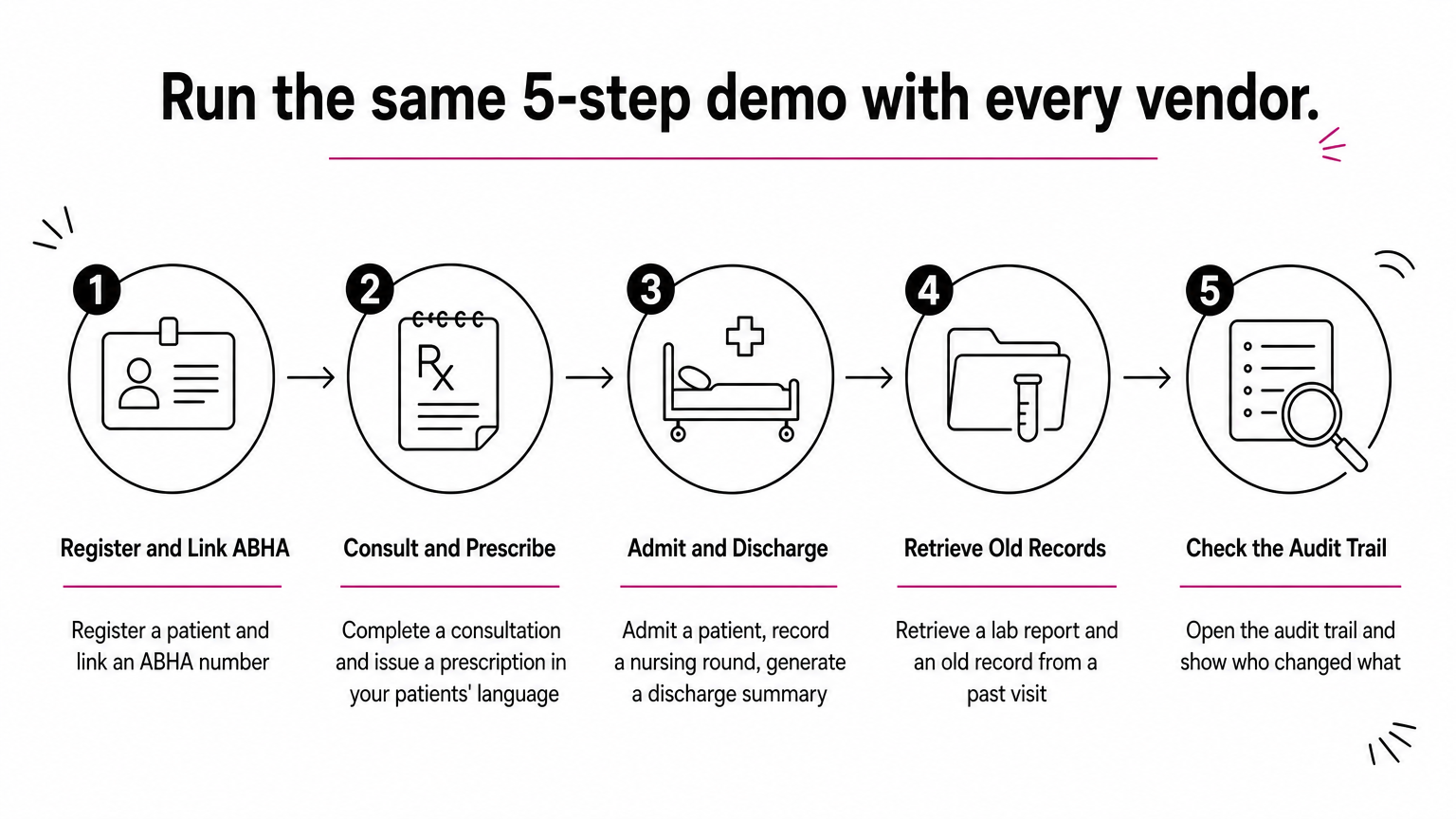
- Register a patient and link an ABHA number.
- Complete a consultation and issue a prescription in the language your patients read.
- Admit a patient, record a nursing round and generate a discharge summary.
- Retrieve a lab report and an old record from a past visit.
- Open the audit trail and show who changed what.
Verify compliance and total cost
Treat any ABDM, NABH or DPDP claim as unproven until you see it work. Cross-check what a vendor says against the official ABDM website. Ask where patient data is stored, who holds the encryption keys and how backups work. For cost, request a written quote that separates licence or subscription, setup, form configuration, data migration, training, support and renewal.
Picking a system you will actually use
Software for electronic medical records only pays off when your staff use it every shift. For a clinic, that points to a lean outpatient tool like Doxxy or Doctors App. For a hospital that wants one vendor, SoftClinic GenX is worth a demo. For a public facility, start with eHospital’s eligibility. For a private hospital with wards still running on paper case sheets, the missing piece is usually inpatient documentation, and that is the gap PurpleIPD fills.
Shortlist two or three systems, run the same demo script with each, and decide on evidence. If your inpatient files are the problem, book a PurpleIPD demo and see your own forms on a tablet before you commit.
