
Picking hospital software India vendors actually deliver comes down to what your hospital still does on paper. If you need a full management system for OPD, billing, pharmacy and lab, compare DocPulse, Caresoft, MocDoc and Aarogya HMIS. If you already run a HIS and your wards still depend on paper IPD files, PurpleIPD fills that gap and does not replace your HIS. A good pick publishes its module list, states its NABH and ABDM position, and tells you how it prices.
The problem is that every vendor page promises "one platform for everything", and few say what it costs. You end up booking five demos to learn what a product page should have told you in two minutes. That wastes your administrator’s and your doctors’ time before you have even narrowed the field.
This article compares five vendors used by Indian hospitals and clinics on features, compliance and pricing. We build PurpleIPD, so it is listed first, and we say plainly what it does not do. Vendor details come from each company’s public pages, so confirm every claim in a demo.
1. PurpleIPD for paperless IPD documentation
PurpleIPD is the right pick when you already have a HIS or HIMS and want to get paper out of your inpatient wards. It is not a full hospital management system. It is the clinical documentation layer that most HIS platforms leave out.

What it covers
PurpleIPD, made by PurpleBits Infosystems in Vadodara, replaces paper IPD files, case sheets and registers with tablet-based forms. Staff write with a stylus on your own forms, scanned in or built with the form builder, so nurses keep their current workflow. Keyboard input works too. It runs on standard Android tablets, including Samsung and Lenovo devices you may already own.
- Setup of your existing paper forms by the vendor team
- Real-time audit trail of every change, login and access
- Video consent recording, including PM-JAY consent
- Flags for missing or incomplete required forms
- Lab report management, plus images, video and audio in the record
- AI-generated discharge summaries from data entered during the stay
Compliance, pricing and fit
The software is built to meet NABH, ABDM, HCX and PMJAY requirements and connects with ABDM and HCX. Data stays on your own server and runs on the hospital LAN with no internet dependency. It is encrypted, access is role-based, and there is a cloud backup. You need a server on site. That is the cost of keeping patient data inside your walls under DPDP. Pricing is by number of tablets or beds, with a custom quote on request, and most hospitals are live in 6 to 8 weeks.
It suits private and mid-sized multi-specialty hospitals with inpatient wards, and new hospitals that want to be paperless from day one. Hospitals report up to a 70% cut in stationery costs, and VIMS Hospital shortened discharge turnaround by 1.5 hours. Skip it if you need billing or pharmacy modules. Keep your HIS for those.
PurpleIPD adds the missing documentation layer to your HIS instead of replacing it.
2. DocPulse for clinics, chains and mid-size hospitals
DocPulse is a cloud-based clinic and hospital management suite from an Indian vendor that covers the whole patient journey from booking to billing. It is a strong choice if you run several clinics or want one vendor for most departments.

What it covers
DocPulse says it has been building healthcare software since 2012 and serves 400+ facilities. Its modules are connected, so data moves between them without re-entry. A single patient bill can combine consultation, lab and pharmacy charges. A central dashboard tracks revenue, patient flow and bed occupancy across branches.
- EMR with specialty-wise templates and drug interaction alerts
- Appointments by online portal, IVR, WhatsApp and walk-in
- Billing with GST reports and TPA claims
- Pharmacy, stock and inventory with expiry alerts
- LIMS with lab machine integration, plus telemedicine
Compliance, pricing and fit
The vendor lists ISO 27001, HIPAA, DPDP alignment and Ayushman Bharat Digital Mission certification. Prices are not published, and the main route is a free demo. It also offers a one-week assisted trial, data migration and a named support specialist after go-live. Ask what the trial includes before you commit staff time to it.
It fits solo practitioners, multi-branch clinic groups and hospitals that want breadth. Because the suite is broad, test the depth of its inpatient charting. Ask to see a full ICU chart and a discharge summary, not only the OPD flow.
DocPulse suits groups that want one connected suite, but check how deep its IPD charting goes.
3. Caresoft for broad modules and listed prices
Caresoft is one of the few vendors in this comparison that publishes starting prices, which makes early budgeting easier. It is a conventional hospital management system with a long module list.
What it covers
Caresoft’s page lists roughly 30 modules, so it competes on breadth. Beyond registration, appointments, EMR, billing and insurance, it includes departments that lighter products skip. A mobile app gives doctors and administrators access to patient data.
- Laboratory, radiology, pharmacy and OT
- Bed, ward and nursing management
- Blood bank, CSSD, diet and canteen
- Inventory, accounts and a Tally interface
- Business intelligence and a report builder
Compliance, pricing and fit
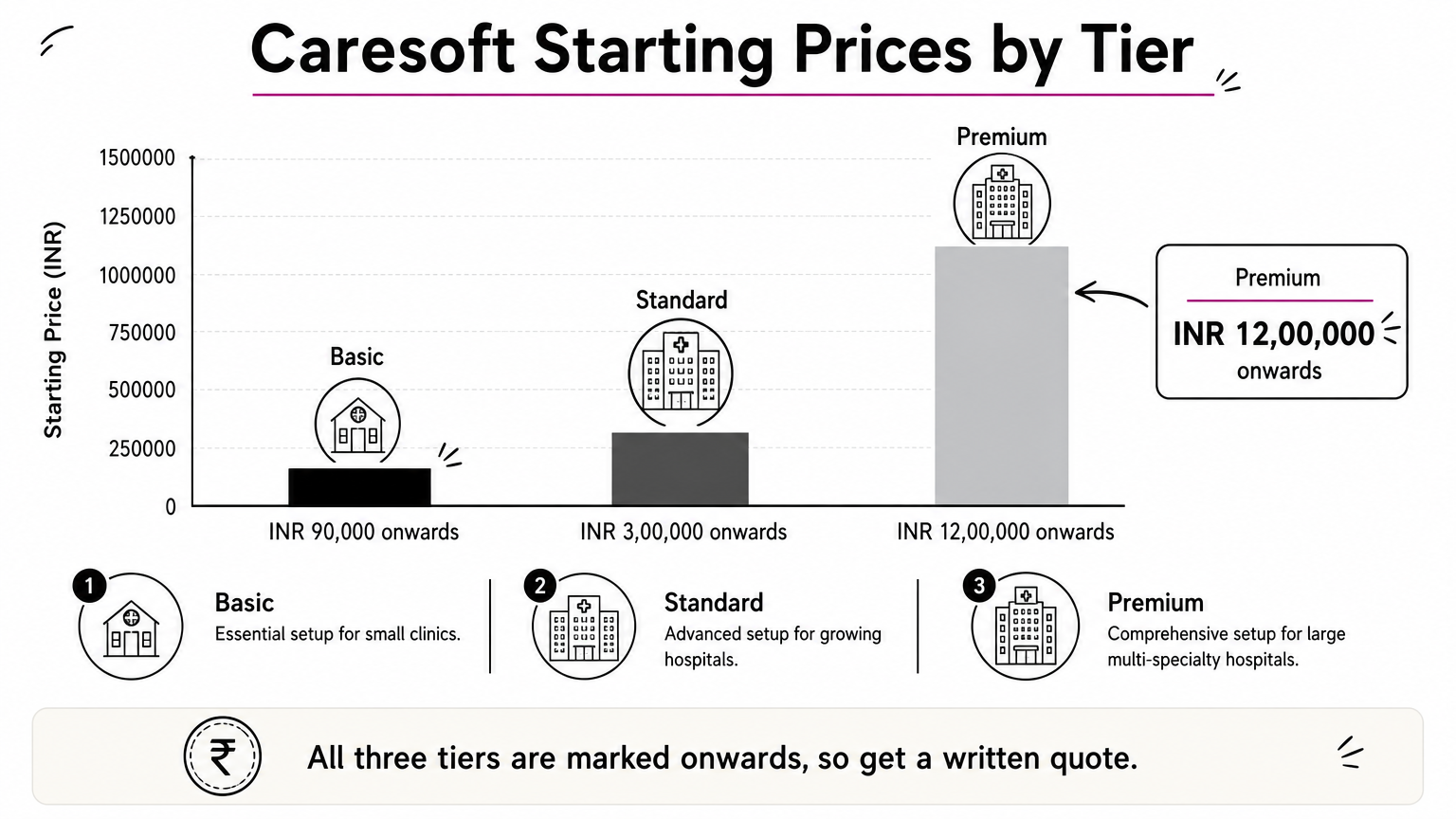
Caresoft lists ISO 27001:2022, PCI DSS and ISO 9001:2015 certifications. Its page does not spell out ABDM or NABH features, so ask for those in writing. It sells three tiers: Basic from INR 90,000, Standard from INR 3,00,000 and Premium from INR 12,00,000. The page marks all three "onwards" and routes you to a quote.
It suits hospitals that want one ERP-style system and can budget from the tier prices. Before you compare it with a subscription product, confirm whether the licence is one-time, what annual support costs, and which modules sit in which tier.
Caresoft gives you a price anchor, but only a written quote tells you the real cost.
4. MocDoc for cloud-based hospital and lab management
MocDoc positions itself as a cloud-based management system for hospitals, labs and clinics. That combination suits you if a hospital, a diagnostic lab and satellite clinics need to share one patient record.
What it covers
The vendor describes EMR, billing, appointments, diagnostics and patient records in one system. The cloud model means no server to maintain and access from any location. That helps if your IT team is small or your clinics are spread across a city.
- EMR and patient record management
- Billing and appointment scheduling
- Diagnostics and lab workflows
Compliance, pricing and fit
Prices are not shown on the public page, so expect a demo-led quote. Treat its compliance position as unverified until you see it in writing. Ask specifically about ABHA linking, HCX claims, NABH documentation and where your data is hosted.
It fits smaller hospitals and lab-heavy practices that prefer cloud hosting. If you are a larger hospital with strict data-residency expectations under DPDP, ask where the servers sit and who can access them.
A cloud system saves you a server, so ask exactly where your data lives.
5. Aarogya HMIS for hospitals of any size
Aarogya HMIS is a full hospital management information system that says it scales from 10-bed clinics to 2,000-bed multi-specialty hospitals. Its main appeal is growth headroom.
What it covers
Aarogya HMIS positions itself as a complete system rather than a point solution. Its public description focuses on that range of hospital sizes, not on individual modules. Ask for the module list for your bed count and check that OPD, IPD, billing, pharmacy and lab are all included in the base price.
A system that serves a 10-bed unit and a 2,000-bed hospital needs configuration at both ends. Ask how it handles multiple wards, many billing counters and several departments at once. Request a reference hospital close to your size.
Compliance, pricing and fit
Pricing and compliance details are not listed on the vendor’s summary page, so request both in writing. Ask whether ABDM integration and NABH checklists are standard features or custom work. Also ask what changes in cost as you add beds.
It suits hospitals that expect to add beds or branches and want to avoid migrating systems later. Visit a live site at your own scale before you sign.
Choose growth headroom only after you have seen the product running at your own bed count.
How to compare hospital software in India
Compare vendors on five things: what the module list covers, how they price, which compliance claims they can prove, where your data sits, and how long go-live takes. The table puts the public facts side by side.
Side-by-side comparison
| Vendor | Type | Deployment | Pricing shown | Compliance stated |
|---|---|---|---|---|
| PurpleIPD | IPD documentation layer next to your HIS | On-premises, hospital LAN | By tablets or beds, custom quote | NABH, ABDM, HCX, PMJAY |
| DocPulse | Clinic and hospital suite | Cloud-based | Demo and quote | ISO 27001, HIPAA, ABDM, DPDP |
| Caresoft | Full HMS, about 30 modules | Not stated | From INR 90,000 / 3,00,000 / 12,00,000 | ISO 27001:2022, PCI DSS, ISO 9001:2015 |
| MocDoc | Cloud hospital, lab and clinic system | Cloud | Quote | Not stated |
| Aarogya HMIS | Full HMIS, 10 to 2,000 beds | Not stated | Quote | Not stated |
Five checks before you sign
Treat every compliance badge as a claim until you see it working. Hospitals in Delhi, Gujarat, Mumbai, Jaipur and Ranchi face different scheme rules, so ask each vendor for a reference in your state. In Rajasthan, ask how RGHS claims are documented.
- Proof of ABDM and NABH support. Ask for a live demo of ABHA linking and a NABH-ready chart, not a brochure.
- Where data lives. On-premises, cloud, or both, and who can access it under DPDP.
- Three-year cost. Add licence, implementation, hardware, training, annual support and per-user or per-bed fees.
- Integration. Interoperability should be standard. Walk away from a "custom API, six months" answer.
- Staff adoption. Ask who configures your forms, who trains nurses, and the realistic go-live time.
Run the cost check against your current spend. If you spend INR 10 lakh a year on stationery, a saving of up to 70% frees up as much as INR 7 lakh a year. That is a number to set against any tool’s price, but a vendor’s claim is a ceiling, not a promise.
The cheapest quote is rarely the cheapest system once support, hardware and rework are added.
Where to start your shortlist
Match the vendor to the gap you actually have. If you need a full system for every department, shortlist DocPulse, Caresoft, MocDoc or Aarogya HMIS and compare them on module depth, written compliance evidence and three-year cost. If your HIS works but your wards still run on paper, a documentation layer is the faster, lower-disruption fix.
Pick two or three vendors, send each the same five checks, and judge them on the answers. A vendor that replies with specifics and a clear price will be easier to work with after go-live too.
If paper IPD files are your problem, book a PurpleIPD demo and see your own forms on a tablet.
