
The top 10 hospital management software in India for 2026 are Healthray, KareXpert, Practo Insta, MocDoc, CliniqWise, Softclinic, Medixcel, HealthPlix, Attune and NIC’s eHospital. The right one depends on your facility type, your pricing model and how far its ABDM support goes. KareXpert and Healthray suit large groups. MocDoc, CliniqWise and Softclinic suit mid-sized hospitals and nursing homes. Medixcel and HealthPlix suit clinics, Attune suits lab-led operations, and eHospital suits government hospitals.
Most shortlists fail because they compare feature lists instead of fit. A 30-bed nursing home and a 500-bed chain do not need the same system. A vendor that hides its price until the sales call makes cost comparison close to impossible. This guide groups the ten products by the facility they serve, so you can cut the list to two or three names quickly.
We build PurpleIPD, a paperless inpatient documentation layer that runs alongside a hospital’s HMS. We see where these systems stop and where ward paperwork stays on paper. We list PurpleIPD last, as an add-on and not as a rival to the ten. The details below come from public vendor listings, so confirm every price and module in a demo.
1. Large hospitals and multi-branch groups
Large hospitals and multi-branch groups should start with KareXpert, Healthray and Practo Insta. All three cover many departments. Their strengths differ: platform breadth, ABDM and AI tooling, or the Practo patient network.
The picks
KareXpert presents itself as a full digital health platform, with HMS, EMR, LIMS, PACS and telemedicine on one stack. It is built for scale, so expect enterprise implementation timelines. A 30-bed hospital will find it heavier than needed, while a 500-bed chain belongs on the shortlist.
Healthray is a cloud HMS covering OPD, IPD, EMR, pharmacy, lab and billing, from single-doctor clinics to multi-speciality hospitals. It lists ABDM/ABHA certification at registration and AI features such as voice-to-text prescription generation. That range suits a group that plans to add branches.
Practo Insta is an established cloud HMS for appointments, billing, EMR and inventory. Its edge is the Practo ecosystem, which ties patient discovery and online presence to the management software. Choose it when that patient channel matters to your intake.
For a multi-branch group, test the rollout across two branches, not a demo in one.
Pricing and what to verify
None of these three publishes a rate card, so price comparison starts with the right questions. Ask each vendor for a written quote that lists every module you need.
| Software | Pricing model | Ask before you sign |
|---|---|---|
| KareXpert | Enterprise, quote-based | Implementation timeline and per-module fees |
| Healthray | Custom | Which AI features sit in the base plan |
| Practo Insta | Quote-based | Per-user charges and which modules are add-ons |
2. Mid-sized hospitals and nursing homes
Mid-sized hospitals and nursing homes get the best fit from MocDoc, CliniqWise and Softclinic. Each covers OPD, IPD, billing and pharmacy at a scale below enterprise chains.
The picks
MocDoc is a cloud-based suite sold as separate products: HMS for hospitals, CMS for clinics, LIMS for labs and PMS for pharmacies. It covers patient management, billing, pharmacy and laboratory services. That makes it a sensible pick if a lab and pharmacy run inside your building.
CliniqWise is a cloud HMS that connects OPD, IPD, EMR, pharmacy and billing, with ABDM M1 to M3 compliance. Its plans are listed from ₹10,000 a year for facilities up to 100 beds, which makes it one of the few options here with a visible starting price.
Softclinic, from JVS Group, has a long install base among small Indian facilities. It covers OPD, IPD, pharmacy and lab under a traditional license model. Check its update policy, support terms and what a second branch would cost.
A starting price is a floor, not a quote, so price your full module list.
Pricing and what to verify
Compare three-year totals, not first-year bills. Take a 60-bed hospital on CliniqWise’s listed starting plan: ₹10,000 a year comes to ₹30,000 over three years, before any add-ons. A license-based product usually adds an upfront payment and annual maintenance on top of that.
| Software | Pricing model | Ask before you sign |
|---|---|---|
| MocDoc | Quote-based | What the base plan includes versus add-ons |
| CliniqWise | From ₹10,000 a year | Which ABDM milestones are live today |
| Softclinic | License-based | Annual maintenance and second-branch cost |
3. Clinics and doctor-first practices
Clinics and solo practices should look at Medixcel and HealthPlix. Both are built around the consultation room, not the ward, so they fit OPD-heavy practices better than hospitals with beds.

The picks
Medixcel, from Plus91 Technologies, has served Indian clinics and small hospitals for years. It covers EMR, appointments, billing and pharmacy. It is a proven, India-built choice for a clinic network that wants one system across branches.
HealthPlix built its name on fast prescription writing. Doctors use its AI-assisted EMR during the consultation, and it has strong regional language support. It is doctor-first rather than facility-first. A hospital that needs IPD, lab and pharmacy management will need more than an EMR.
If your doctors will not use the screen during the consultation, no feature list will save the rollout.
Pricing and what to verify
Per-doctor pricing is simple at the start and grows with every consultant you add. A clinic with three doctors pays for three seats, and a fourth joining next year raises the bill. Ask both vendors for a price at your expected headcount in two years.
| Software | Pricing model | Ask before you sign |
|---|---|---|
| Medixcel | Quote-based | What the base plan includes versus add-ons |
| HealthPlix | Per doctor | Cost at your headcount in two years |
4. Labs and government hospitals
Diagnostic chains should evaluate Attune, and eligible government hospitals should look at eHospital from NIC. These two serve narrow audiences, which is why they are the clearest picks on this list.
The picks
Attune offers LIMS and HIS products with real depth in laboratory workflows. It suits diagnostic chains and hospitals where the lab drives revenue. Compare its lab depth against any standalone lab system on price before you decide.
eHospital is the National Informatics Centre’s HMS for government hospitals. It is free and ABDM-aligned, and it runs across many public facilities. Private facilities generally cannot adopt it, and support follows government processes rather than commercial service agreements. For an eligible government hospital, it is the default answer.
Free software is only free if your facility qualifies and you can live with government-process support.
Pricing and what to verify
Attune prices by quote, so ask for the lab modules separately from the hospital modules. For eHospital, the cost is not the licence but the effort: confirm eligibility with NIC, and ask who handles customization and support at your site.
| Software | Pricing model | Ask before you sign |
|---|---|---|
| Attune | Quote-based | Lab module price versus the full HIS |
| eHospital (NIC) | Free for eligible government hospitals | Eligibility, support channel and customization |
5. Paperless IPD documentation on top of your HMS
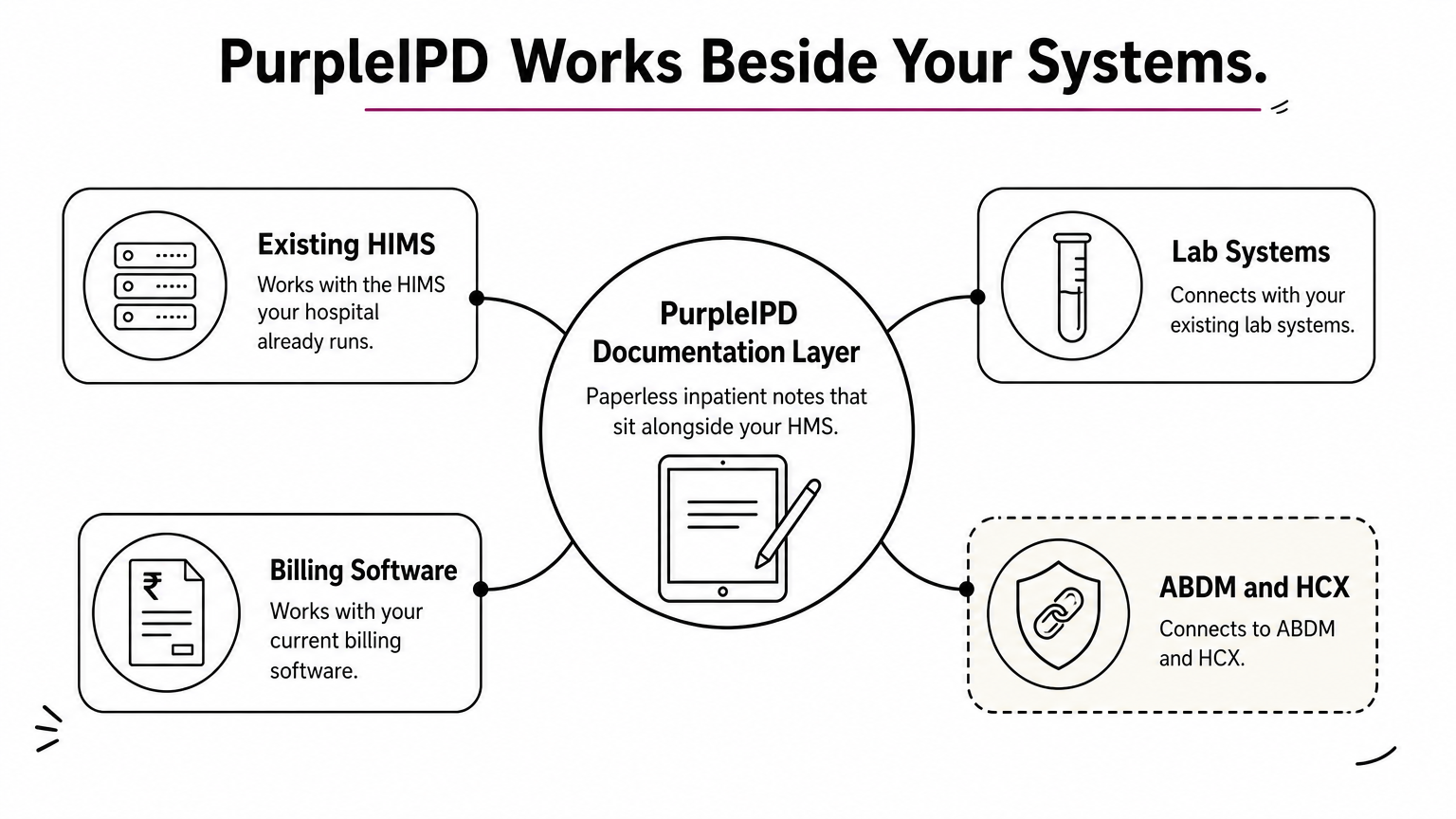
PurpleIPD is not a replacement for any of the ten above. It is the paperless inpatient documentation layer that sits alongside your HMS, so case sheets, nursing notes and consent forms stop living in paper files. Many hospitals run an HMS for billing and orders and still keep the IPD file on paper.
How it works
Staff write with a stylus on standard Android tablets, Samsung or Lenovo, over scanned versions of your existing forms or custom forms from a form builder. Data goes in during the round, not after it. PurpleIPD runs on the hospital LAN with no internet dependency, and it works with your existing HIMS, lab systems and billing software. It also connects to ABDM and HCX.
Control features matter for audits. A real-time audit trail records every change, login and access, and compliance flags catch missing forms before discharge. Video consent recording and role-based access come built in. VIMS Hospital cut discharge turnaround by 1.5 hours, and hospitals report up to a 70% drop in stationery costs.
Your HMS handles billing and orders, and PurpleIPD takes the paper out of the ward.
Pricing and what to verify
Pricing follows the number of tablets deployed or the number of beds, and you get a custom quote on request. Budget for an on-premise server too, since your patient data stays in your own infrastructure.
| Item | Detail |
|---|---|
| Pricing model | By tablets or beds, custom quote |
| Deployment | On-premise, runs on hospital LAN |
| Hardware | Standard Android tablets with stylus |
| Go-live | About 6 to 8 weeks, including form setup |
| Compliance | NABH, ABDM, HCX and PMJAY requirements |
Choosing your shortlist
Pick by facility type first, then by pricing model, then by ABDM milestones that are live today. Large groups should compare KareXpert, Healthray and Practo Insta. Mid-sized hospitals should compare MocDoc, CliniqWise and Softclinic. Clinics should look at Medixcel and HealthPlix, labs at Attune, and eligible government hospitals at eHospital. Ask every vendor for a written quote at your expected size, and compare three-year totals.
Whichever HMS you choose, check what happens to the inpatient file. If case sheets and consent forms still live on paper, you keep paying for printing, storage and slow discharges. When you are ready to fix that layer, book a PurpleIPD demo and see it run next to your HMS.
