

A hospital’s medical records department (MRD) is the unit that creates, organizes, protects and releases every patient’s health record. Medical records department functions fall into six groups: registration and record creation, storage and retrieval, coding and indexing, hospital statistics, release of information, and confidentiality. The MRD is the custodian of the record, not its author. Doctors and nurses write the chart, and the MRD makes sure it is complete, findable and safe.
This article explains why the department matters, then walks through each function in the order a file moves through the hospital. You also get a worked example of the statistics an MRD reports, a daily routine for running the department, and a look at how paperless documentation changes the work.
We build PurpleIPD, paperless IPD software for Indian hospitals. The explanations below hold whether your records are on paper, digital or a mix of both.
Why the medical records department matters
The medical records department matters because the patient record is the only complete account of a hospital stay, and care, billing, law and management all depend on it. The functions of a medical records department in a hospital are not clerical extras. They decide whether a doctor finds last year’s discharge summary, whether a claim gets paid and whether an audit goes smoothly.
The MRD does not write the record, but it decides whether the record can be trusted.
Who depends on the record
Six groups use the same file, and each needs something different from it:
- Treating team: history, allergies, earlier results, so tests are not repeated.
- Billing and insurance desk: proof of treatment for claims and TPA queries.
- Quality and NABH coordinators: evidence for audits and record-completeness checks.
- Legal and administration: documents for disputes and medico-legal cases.
- Management: statistics for planning beds, staff and services.
- Patients: discharge summaries and certified copies.
What a weak department costs you
A weak MRD shows up first as delay. A file that cannot be found holds up an OPD review, and an incomplete discharge summary holds up the bill and the insurance claim.
The second cost is audit exposure. Missing consent forms, unsigned notes and unreliable occupancy numbers are findings that an assessor spots quickly. The third cost is money tied up in paper, storage space and the staff who fetch files all day.
Registration, storage and retrieval of records
The first group of functions covers a record’s life from registration to the shelf: creating it, checking it, storing it and finding it again.
Registration and record creation
The department registers new and returning outpatients, issues the OPD file or card, and assigns each patient a unique hospital ID. Emergency registration usually runs round the clock. For inpatients, the MRD or admission desk opens the IPD file at admission and links it to the patient’s existing record. Many hospitals now also capture the patient’s ABHA number at this point.
Getting the identity right here prevents duplicate files, and duplicates are the root of most "record not found" complaints.
Assembling and checking the inpatient file
After discharge, the ward sends the file to the MRD. The team arranges it in a fixed order and runs a deficiency check. Typical checks:
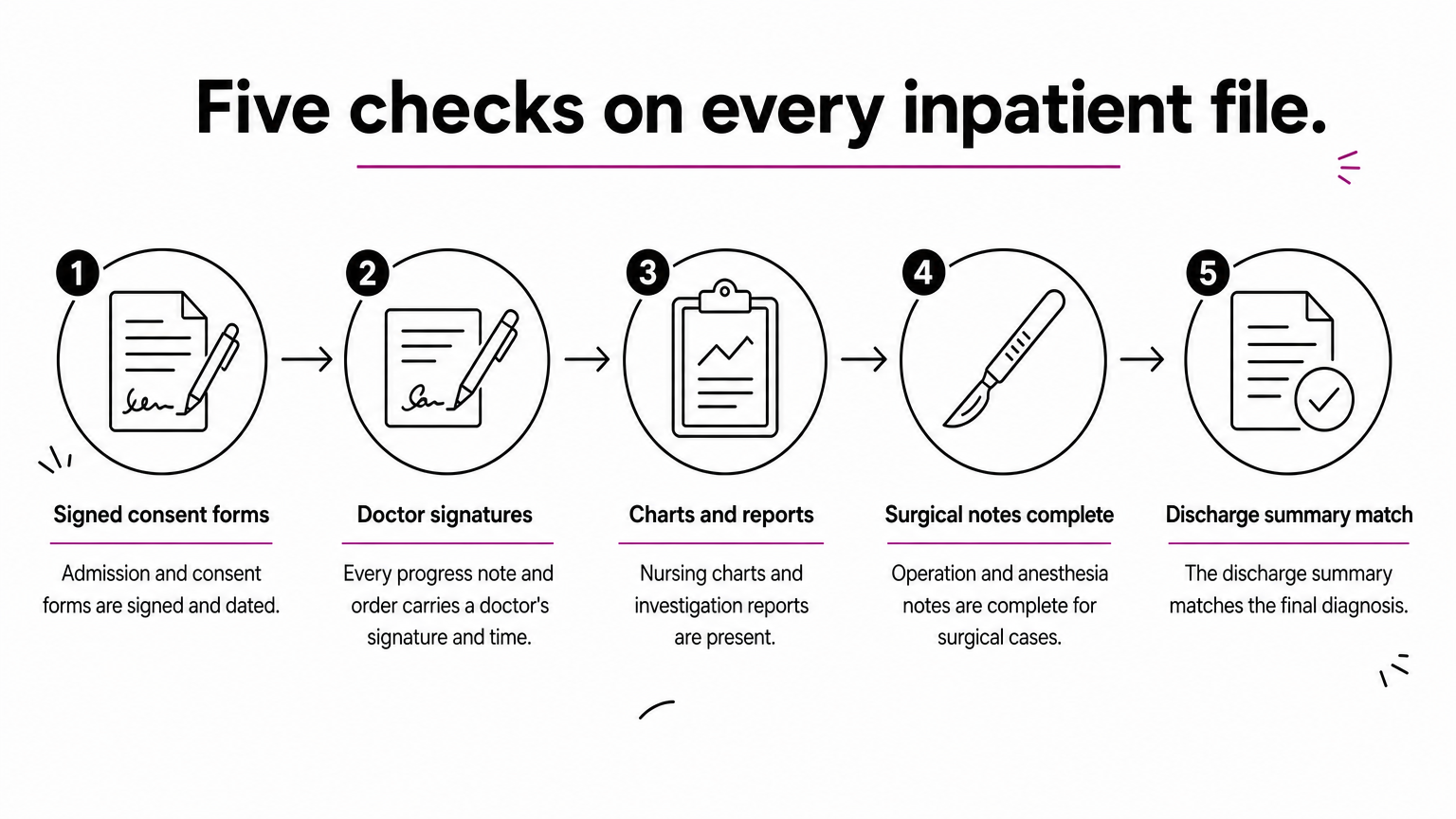
- Admission form and consent forms are signed and dated.
- Every progress note and order carries a doctor’s signature and time.
- Nursing charts and investigation reports are present.
- Operation and anesthesia notes are complete for surgical cases.
- The discharge summary matches the final diagnosis.
Deficiencies go back to the responsible doctor on a list with a deadline.
A record is not finished at discharge. It is finished when the MRD has checked it.
Storage, retrieval and retention
Completed files are filed under a serial or terminal-digit numbering system and tracked with a requisition slip and a tracer card, so you always know who holds which file. Retrieval speed depends on this discipline more than on shelf design.
Retention rules vary by record type and by regulation. The 2002 medical council professional conduct regulations asked for a minimum of three years for indoor records, and most hospitals keep them longer, especially medico-legal and pediatric files. Confirm the current requirement with your legal advisor, and log every authorized destruction.
Coding, statistics and release of information
The second group turns stored records into usable information, and controls who may see them.
Coding and indexing
Coders assign ICD-10 codes to diagnoses and standard codes to procedures, using the final diagnosis in the discharge summary. Indexing then builds the lookups: a master patient index, a disease index, an operation index and often a doctor index. These let you pull every case of a given diagnosis for research, a clinical audit or an insurance query without opening files one by one.

Hospital statistics
The MRD compiles the daily census and the monthly indicators that management uses. Here is a worked example for a 100-bed hospital over 30 days, with 2,400 inpatient days and 600 discharges, of which 12 were deaths.
| Indicator | Formula | Result |
|---|---|---|
| Bed occupancy rate | Inpatient days ÷ (beds × days) × 100 | 2,400 ÷ 3,000 × 100 = 80% |
| Average length of stay | Inpatient days ÷ discharges (including deaths) | 2,400 ÷ 600 = 4 days |
| Bed turnover rate | Discharges ÷ beds | 600 ÷ 100 = 6 per bed |
| Hospital death rate | Deaths ÷ discharges × 100 | 12 ÷ 600 × 100 = 2% |
Release of information, certificates and confidentiality
The MRD releases information only on a written request from a person entitled to it: the patient, an authorized representative, the police through a written requisition, an insurer with the patient’s consent, or a court. Staff verify ID, log the release and keep a copy of the authorization. The department also prepares medico-legal certificates and case summaries, and intimates births and deaths to the local registrar under the Registration of Births and Deaths Act, 1969.
Confidentiality is the rule behind all of it. Files stay in the department, access is limited by role, and India’s Digital Personal Data Protection Act, 2023 adds duties for anyone who holds patient data.
Every release of a record should be requested in writing, verified and logged.
How to run the department day to day
Run the department on a fixed daily routine and a few monthly checks, instead of reacting to missing files and audit deadlines.
A daily routine that works
- Collect the previous day’s discharge files from the wards by a fixed time.
- Run the deficiency check and send the list to doctors with a deadline.
- Code the completed files.
- File them and update the tracer or location register.
- Process release requests, and log each one with ID and authorization.
- Close the day by updating the census and statistics.

Each step has one owner. When ownership is vague, deficiency lists pile up and files drift.
Checks to track every month
Pick a handful of measures and review them with your quality coordinator:
- Share of sampled files that are fully complete.
- Average time to retrieve a requested file.
- Files out on loan beyond the agreed period.
- Turnaround time for release requests.
- Deficiencies pending beyond the deadline.
Set your own targets from your current numbers. NABH information management standards expect documented policies and periodic record audits, so this log doubles as audit evidence.
How paperless IPD changes these functions
Paperless IPD documentation moves record creation and checking to the point of care, and leaves the MRD team with oversight, coding and release decisions.
What moves to the tablet
| Function | Paper MRD | With PurpleIPD |
|---|---|---|
| Record creation | Printed forms, handwritten | Staff scribble on digitized versions of your own forms |
| Completeness check | After discharge, by hand | Missing forms are flagged during the stay |
| Accountability | Signatures, if present | Audit trail of every change, login and access |
| Access control | Key to the record room | Role-based access control |
| Retrieval | Walk to the shelf | Search the digital record |
PurpleIPD sits alongside your existing HIMS, lab and billing systems and also supports digitizing historical paper records. Hospitals have reported up to a 70% reduction in stationery costs.
What stays with your MRD team
Software does not replace judgment. Coders still assign codes, the MRD head still decides whether a release request is valid, and someone still owns the confidentiality policy and the monthly audit.
Going paperless removes the shelves, not the responsibilities of the department.
Putting the functions to work
The medical records department creates the record, checks it, stores it, codes it, reports on it and releases it under strict control. Strong departments run these functions as a routine with named owners and a few measured checks. Weak ones discover problems at discharge, at claim time or at the audit.
Start by mapping your own file from registration to storage and marking where it stalls. If most of the delay sits in paper handling, retrieval and deficiency chasing, it is worth seeing what a digital workflow removes. You can book a PurpleIPD demo to see how your existing forms would run on tablets with your MRD team still in control.
