
The right hospital software management choice depends on the gap you need to close. If registration, billing and pharmacy already run on a system but your inpatient wards still use paper, add a documentation layer such as PurpleIPD. If you need one platform for hospital patient management software from the front desk to the lab, compare SoftClinic GenX, MocDoc, eMedHub and CognitiSoft.
Most hospitals in Gujarat face a mix of both problems. Files go missing, discharge waits on one incomplete form, and NABH or ABDM audits eat staff time. Every vendor also says "cloud-based" and "NABH-ready," which makes the options hard to tell apart.
This list sorts five options by the type of hospital each one suits, with what each covers and what to ask before you sign. We make PurpleIPD, so it comes first, and we say plainly where it does not fit. Facts about the other four come from how each vendor describes itself, so confirm them in a live demo.
1. PurpleIPD for paperless inpatient wards
PurpleIPD is paperless IPD software that replaces paper case sheets, IPD files and registers with tablet documentation. It is a clinical documentation layer, not a full HIS, so it runs beside your existing HIS or HIMS, lab system and billing software.

What it covers
Staff scribble with a stylus on scanned versions of your own forms, so your existing paper forms are digitised instead of replaced with generic templates. A form builder handles new forms. The core features:
- Audit trail that tracks every change, login and access
- Video consent recording, including PM-JAY consent
- Flags for missing or incomplete forms
- Images, videos and audio attached to patient records
- Lab report management and AI-generated discharge summaries
- NABH, ABDM, HCX and PMJAY compliance support
A documentation layer fixes the paper problem in your wards without forcing you to replace the HIS you already run.
Who it suits and what to ask
It suits private and mid-sized multi-specialty hospitals that already have a HIS but still run wards on paper, and new hospitals that want to be paperless from day one. It runs on standard Android tablets (Samsung or Lenovo with stylus), on your hospital LAN with no internet dependency, with cloud backup. PurpleBits Infosystems builds it in Vadodara.
Pricing depends on the number of tablets or beds, quoted on request. Rollout usually takes 6 to 8 weeks, and the team configures your forms and trains doctors and nurses. As an illustration, a hospital spending ₹10 lakh a year on stationery could save up to ₹7 lakh at the claimed 70% reduction. Your real figure depends on your volumes.
2. SoftClinic GenX for hospitals that want local references
SoftClinic GenX is a hospital management system that its vendor says is used by hospitals across Gujarat. The vendor names Ahmedabad, Surat, Rajkot and Vadodara among its locations.
What it covers
SoftClinic positions GenX as a full HMS, meaning a single system for hospital operations rather than a layer on top of another one. Its public page does not give a module list that we can rely on here, so use your demo to build one. Check these points:
- Which modules ship by default and which cost extra
- How inpatient clinical notes are captured, typed or handwritten
- What reports management gets without custom work
A vendor with live hospitals in your city can show you a working installation, which is worth more than any feature list.
Who it suits and what to ask
It suits hospitals that want a single-vendor HMS and value a supplier with a visible Gujarat footprint. Local presence also means on-site support is more realistic.
Ask for a reference hospital of similar bed size in your own city, and visit it. Get a written quote that lists modules, user counts, support hours and data migration separately.
3. MocDoc for cloud hospital and lab management
MocDoc offers cloud-based hospital, lab and clinic management software, and says it is NABH compliant. It has a Gujarat page aimed at local providers.
What it covers
Its description stresses diagnostics workflows alongside hospital management. That makes it relevant if lab turnaround is a bottleneck for you. Stated coverage:
- Hospital management
- Laboratory management
- Clinic management
If your lab is the slowest link in patient flow, a system built with diagnostics in mind deserves a close look.
Who it suits and what to ask
It suits small to mid-sized hospitals and standalone clinics that prefer cloud hosting over running a server. A cloud system cuts your hardware spend but ties daily work to your internet connection.
Ask what happens when connectivity drops, and whether wards can keep working offline. Ask which NABH documentation checks are built in rather than handled by your own staff, since "compliant" can mean very different things.
4. eMedHub for ABDM-focused hospitals
eMedHub is cloud-based HIMS and EHR software that describes itself as ABDM-verified and NABH-ready, with 23+ modules. Its Gujarat page targets hospitals and clinics in Gandhinagar.
What it covers
The pitch is breadth: hospital information management and electronic health records in one product, with a long module list. The stated highlights:
- HIMS plus EHR in one platform
- ABDM verification
- NABH readiness
- 23+ modules
More modules only help if your staff will use them, so buy for the workflows you run today.
Who it suits and what to ask
It suits hospitals that want ABDM integration handled by the vendor, especially those planning ABHA-linked records. Gujarat hospitals near the state capital may also find support easier.
Ask to see the ABDM verification for the exact version you will install. Then list the modules you need out of the 23+, and ask what each one costs. Paying for a full suite while using six modules is the common mistake.
5. CognitiSoft for all-in-one OPD to EMR
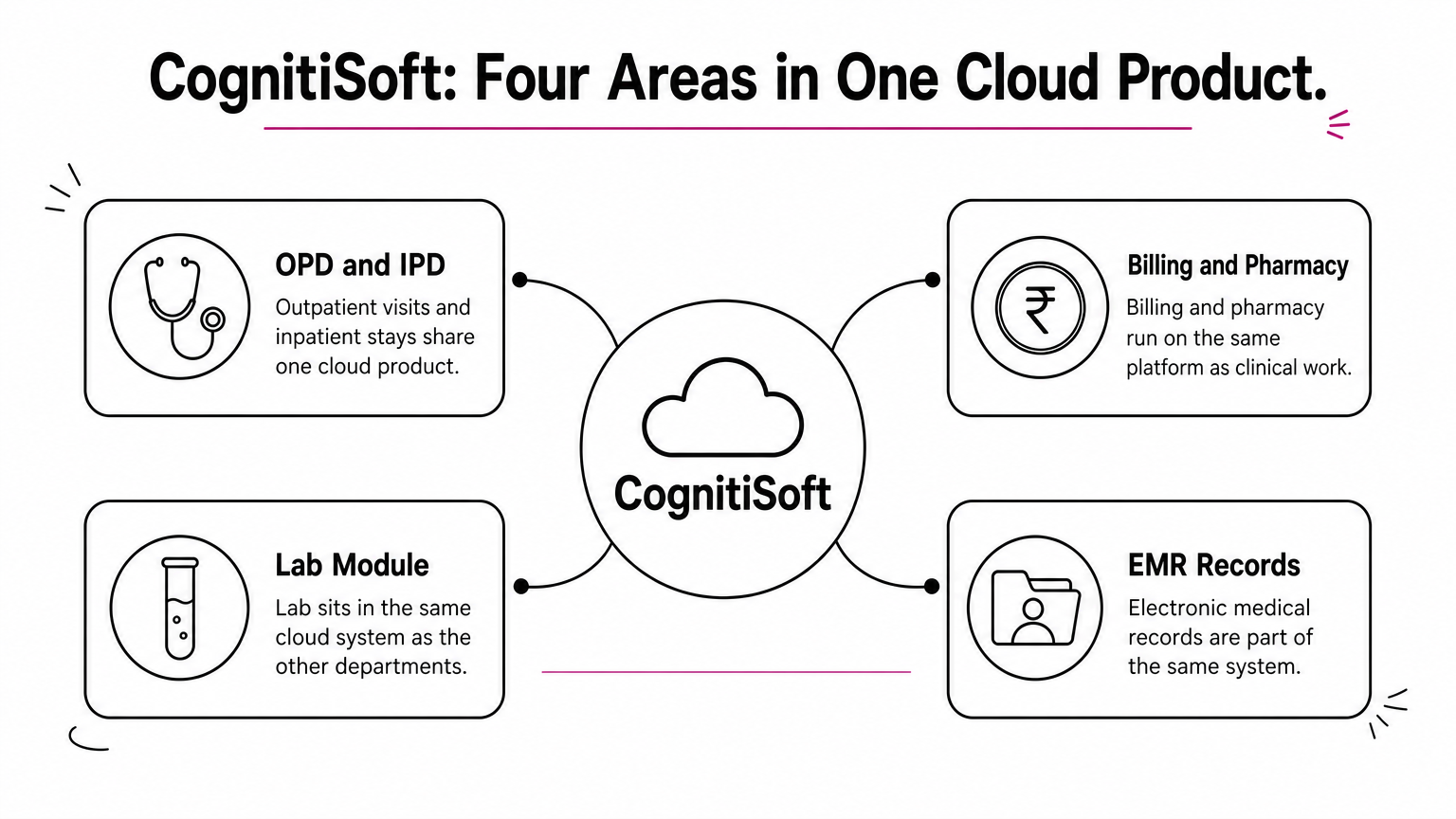
CognitiSoft offers secure, cloud-based hospital management software covering OPD, IPD, billing, pharmacy, lab and EMR. It also has a page for hospitals in Ahmedabad.
What it covers
This is the closest match to a classic patient management system, with the main departments in one cloud product:
- OPD and IPD
- Billing and pharmacy
- Lab
- EMR
The real test of an all-in-one system is whether OPD, IPD, billing and pharmacy truly share a single patient record.
Who it suits and what to ask
It suits mid-sized hospitals in Ahmedabad and nearby that want standard departments on one platform without a large IT team. Cloud hosting keeps setup light.
During the demo, admit a test patient and follow them to discharge and billing. Watch for re-entered data between departments. Also ask how IPD notes are recorded at the bedside, because many HMS products capture orders and billing well but leave ward documentation on paper.
Picking the right fit for your hospital
Decide first whether you need a full HMS or a documentation layer. A full system such as the four cloud options above runs registration, billing, pharmacy and lab. A layer such as PurpleIPD removes paper from your wards and works with the HIS you already have.
Whichever you shortlist, insist on a demo with your own forms and a reference hospital in your city. If your inpatient wards still run on paper, see how PurpleIPD works in your wards.
