
The hospital medical records department is the unit that receives, checks, codes, stores and releases every patient’s clinical file. In Indian hospitals you will also hear it called the MRD, the medical records section or the health information management unit. Its job is simple to state. It makes sure the right record exists, is complete, can be found in minutes, and is seen only by people who are allowed to see it.
This article explains why the department matters, what it does with a file from admission to release, and who works in it. It also covers how records are numbered, filed and retrieved, and how hospitals move the work from paper rooms to digital systems.
PurpleIPD builds paperless inpatient documentation software for Indian hospitals. The MRD’s everyday problems, such as misplaced files, slow retrieval and chasing missing signatures, are the ones we work on.
Why the medical records department matters
The department matters because every clinical, legal and financial decision in a hospital rests on the file it controls. When that file is missing or incomplete, care, claims and audits all suffer at once.
One file, five users
A single inpatient file serves several readers at the same time. The department is the one place accountable for all of them:
- Clinicians read it to continue treatment, especially when a patient is readmitted.
- Lawyers and courts use it as evidence of what was done and whether consent was taken.
- Insurers and TPAs pay claims only against documented proof.
- Assessors, such as NABH, check that records are complete, identifiable and retrievable.
- Administrators draw bed occupancy, mortality and disease statistics from it.
What a weak department costs you
Delays show up first at discharge. A file with a missing signature, consent form or discharge summary holds up the final bill, and the patient waits while a nurse hunts for the doctor. Gaps found after discharge are worse, because the treating team has moved on and memory has faded.
A weak department also costs money. Printing, shelving, rooms and clerks add up to lakhs every year in many hospitals.
A record you cannot find, or cannot trust, is worth nothing in care, court or claims.
What the department does with a patient file
The department moves each inpatient file through a fixed sequence, from the number issued at registration to the day it is archived. Skipping a step is how files get lost or arrive incomplete.
The path of an inpatient file
- Registration: the patient gets a unique MR or UHID number, and every page carries it.
- Assembly: after discharge, the ward sends the file and staff arrange the pages in a fixed standard order.
- Deficiency check: staff look for missing signatures, consents, notes and the discharge summary.
- Coding: a coder assigns diagnosis and procedure codes, using ICD-10 for diagnoses.
- Indexing and statistics: the file is entered in the indexes, and counts feed census, occupancy and mortality reports.
- Filing: the file goes to its shelf position under the hospital’s numbering system.
- Retrieval and release: files leave only against a written request and return with a log entry.

Why the deficiency check matters most
This step decides record quality. Do it within a day or two of discharge, while the treating team still remembers the case. Staff write each gap on a deficiency slip and send it to the responsible doctor or nurse. The file is not marked complete until every gap is closed.
Coding comes next, and accurate codes matter. They shape how a claim is categorized and what your hospital statistics say. A wrong or missing code can also trigger a TPA query, so it helps when the coder and the billing desk work from the same final file.
The deficiency check turns a pile of pages into a record you can defend.
How the department is organized and staffed
Most hospitals organize the department by function, with a medical records officer in charge and technicians, coders and clerks working under that officer. Size changes with bed count, but the functions stay the same in a 50-bed hospital and a 500-bed one.
Units inside the department
A typical department has separate working areas for assembly and analysis, coding and statistics, filing and retrieval, and release of information. In a small hospital one person may cover two areas. The duties should still be written down.
The head often reports to the medical superintendent. In some hospitals the report goes to the quality head instead, because the department carries much of the NABH readiness work.
Staff roles
| Role | Main responsibility |
|---|---|
| Medical records officer | Heads the department, sets filing and retention rules, handles audits and medico-legal requests |
| Medical record technician | Assembles and analyses files, runs deficiency checks, maintains indexes |
| Coder | Assigns diagnosis and procedure codes from the notes and discharge summary |
| Statistician or data entry operator | Compiles census, occupancy, mortality and morbidity reports |
| Filing and retrieval clerk | Files records, issues them against requests, logs every movement |
Officers and technicians generally come from diploma or degree courses in medical records or health information management, and some institutions run one-year programs for technicians. When you hire, look for attention to detail over speed, because one misfiled page can cost a claim or a court case.
Whatever your hospital’s size, every function needs a named owner, even if one person owns three.
How records are stored and retrieved
Records are stored under one permanent patient number, shelved in a fixed order, and issued only against a logged request. The numbering and filing system decides whether a file takes two minutes or two hours to find.
Numbering and filing systems
Serial numbering gives a new number at every admission. Unit numbering gives one number per patient for life and keeps every admission in one file. Unit numbering suits hospitals with frequent readmissions, since the full history sits together.

Filing then follows one of three methods:
| Filing method | How it works | Trade-off |
|---|---|---|
| Straight numerical | Files shelved in ascending number order | Easy to learn, but staff crowd at the newest shelves and misfiles are common |
| Terminal digit | Number read in pairs, filed by the last pair first (48-23-17 goes to section 17) | Spreads work evenly across shelves, but needs training |
| Colour coded | Coloured labels mark year or digit groups | A misfile shows at a glance, so combine it with either method above |
Retrieval, retention and a worked example
For retrieval, set a simple rule. Files leave the room only against a written request from an authorised person, a tracer slip stays on the shelf, and the return is logged. Keep the room locked, with access limited to department staff.
Retention needs a written policy. Indian medical ethics regulations have long asked for inpatient records to be kept for at least three years, and many hospitals keep them longer, especially for medico-legal cases. Confirm your period with your legal advisor.
Here is what that means in practice. Take a 100-bed hospital at 70% occupancy with a four-day average stay. That is about 6,400 admissions a year. At roughly 40 pages a file, you handle about 2.5 lakh pages a year. Over a three-year minimum you hold around 19,000 files to shelve, index and protect from damp and pests.
Storage is not the hard part of records management. Finding the right file quickly, every time, is.
How to move a paper department toward digital records
Start by digitizing documentation at the ward, not by scanning files after discharge. That fixes gaps at the source. A phased move works better than an overnight switch, because staff keep working while they learn.
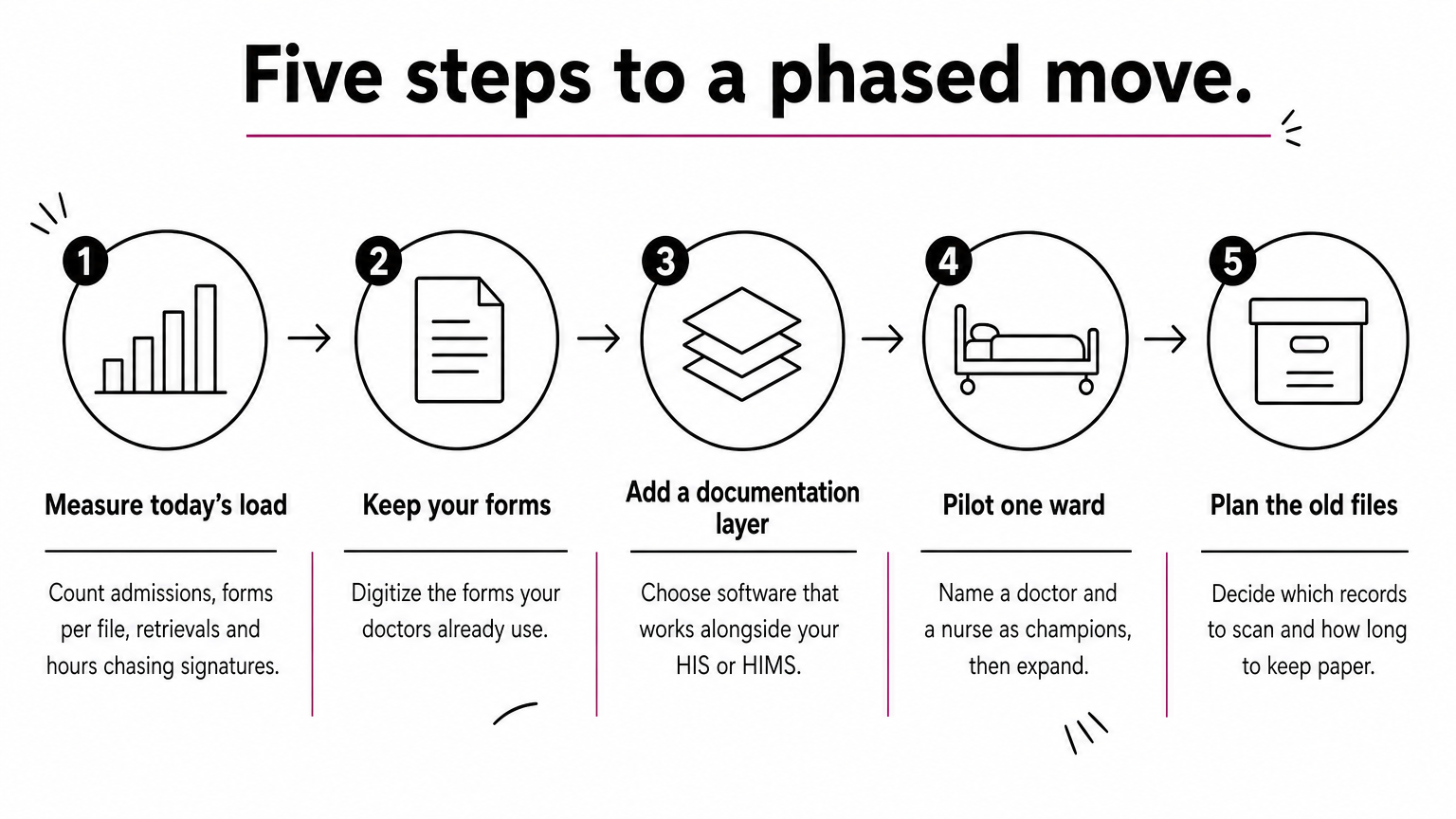
Five steps for a phased move
- Measure today’s load: count monthly admissions, forms per file, retrieval requests and hours spent chasing missing signatures.
- Keep your forms: digitize the forms your doctors already use instead of redesigning them.
- Add a documentation layer: choose software that works alongside your HIS or HIMS, not instead of it.
- Pilot one ward: name a doctor and a nurse as champions, then expand ward by ward.
- Plan the old files: decide which historical records to scan in bulk, which on demand, and how long to keep the paper.
Where PurpleIPD fits
PurpleIPD is built for step 3. Staff write with a stylus on scanned versions of your own forms, or on custom digital forms from its form builder. It runs on standard Android tablets, including Samsung and Lenovo models. Data stays on your own infrastructure, and the system works with your HIMS, lab and billing software.
The audit trail tracks every change, login and access. Automated compliance checks flag missing forms, so the deficiency check happens during the stay, not weeks later. The PurpleIPD team configures your existing paper forms, and most hospitals are up and running within 6–8 weeks. Hospitals have seen up to a 70% reduction in stationery costs.
The best deficiency check happens before the patient leaves, not after the file reaches the MRD.
Making the department work for you
A hospital medical records department is the unit that keeps clinical files complete, findable and confidential. It does this through a fixed path for every file, clear roles, a numbering and filing system, a retrieval log and a retention policy. When those are in place, discharges move faster, claims face fewer queries and audits stop being a scramble.
If your department still runs on paper, you don’t need to change how your doctors work. Start by measuring what the paper costs you today, then move documentation to the ward in phases. To see how that looks on tablets with your own forms, explore PurpleIPD’s paperless IPD documentation.
