
The best hospital administration software for your hospital depends on one question: do you need a full system, or a layer on top of the one you already run? If you have an HIS and still keep paper case sheets, PurpleIPD fits. For an all-in-one system, look at SoftClinic GenX or CognitiSoft. If ABDM and NABH readiness come first, start with eMedHub. For a published per-bed price at a small hospital, CureNearMe is the one to check.
Hospitals in Ahmedabad, Gandhinagar, Vadodara and across Gujarat face the same problem when they shop. Every vendor claims a complete system with OPD, IPD, billing, pharmacy, lab and EMR. The real differences sit elsewhere: cloud or on-premises deployment, how ward documentation is handled, how deep the ABDM support goes, and how the vendor prices.
This article compares five options with the same three headings, so you can set them side by side. PurpleIPD is our own product. We list it first because it solves a different problem from the other four, and we say plainly where it does not fit. The other four are described as they present themselves, so confirm each point in a demo.
1. PurpleIPD
What it covers
PurpleIPD is paperless IPD documentation for Indian hospitals, built by PurpleBits Infosystems in Vadodara. It digitizes your existing paper forms, so doctors and nurses write with a stylus on a tablet much as they do on paper.

- Custom digital forms, set up from your actual forms, plus a form builder
- Audit trail of every change, login and access
- Video consent recording, including PM-JAY consent
- Flags for missing or incomplete forms
- Lab report management and integrated OPD and IPD documentation
- ABDM, HCX, NABH and PMJAY support
PurpleIPD fills the ward-documentation gap that a standard HIS leaves open.
Who it suits
It suits private and mid-sized hospitals that already run an HIS but still depend on paper IPD files. VIMS Hospital cut discharge turnaround by 1.5 hours, and hospitals report up to a 70% drop in stationery costs.
It does not suit a clinic that wants one product for registration, billing and pharmacy. PurpleIPD works with your existing HIMS, lab and billing software, so you still need those.
Pricing and rollout
Pricing depends on the number of tablets or beds, and you get a customized quote. Most hospitals go live in 6 to 8 weeks, with the vendor handling form setup and training.
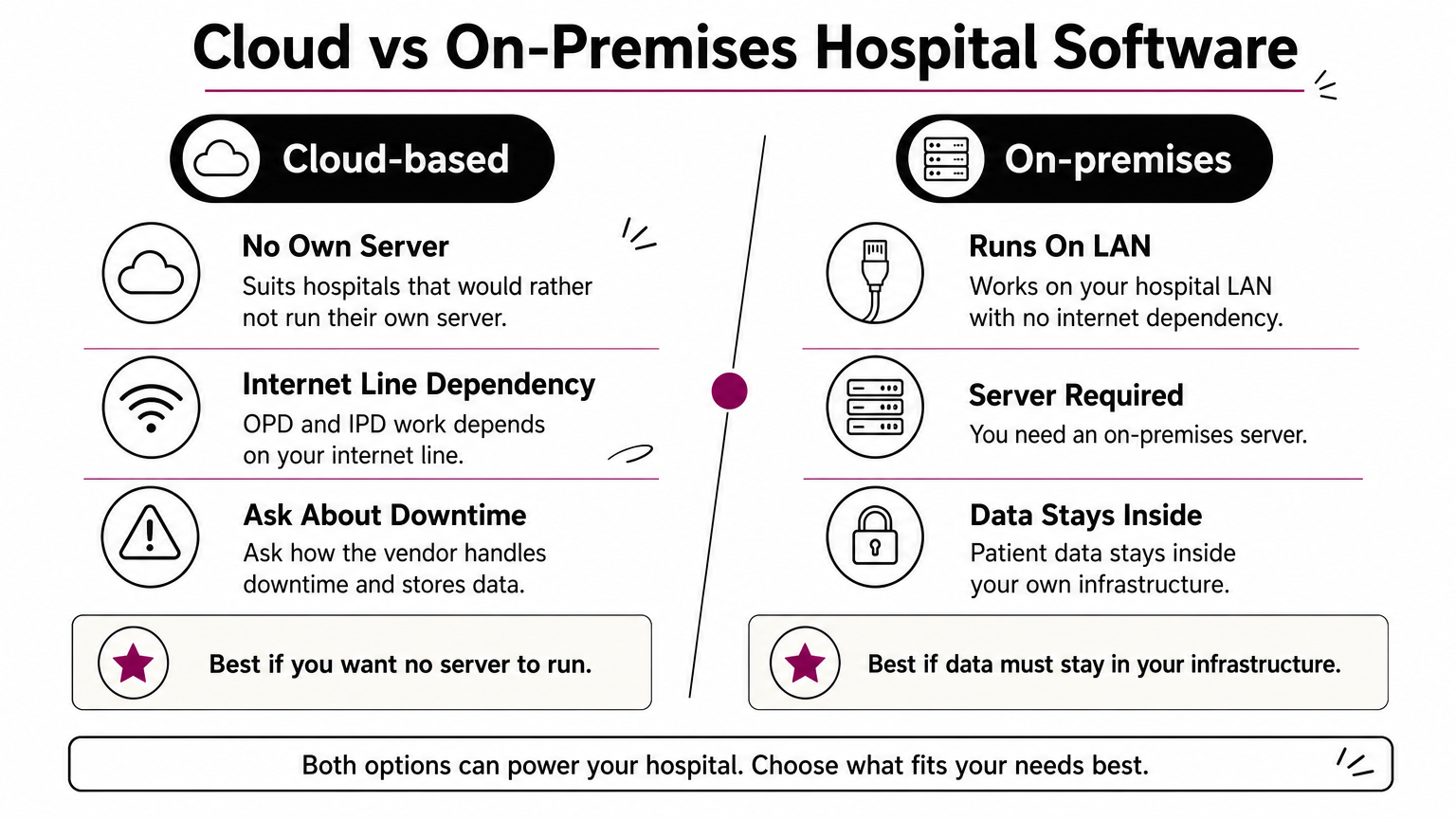
It runs on your hospital LAN with no internet dependency, on standard Android tablets with a Samsung or Lenovo stylus. You need an on-premises server. That keeps patient data inside your own infrastructure, which helps with DPDP obligations.
2. SoftClinic GenX
What it covers
SoftClinic GenX is hospital software that targets Gujarat hospitals of every size, with a page for Ahmedabad. Its listing covers registration, OPD and IPD, wards, operation theatre and billing, so it aims to be the one system the whole hospital runs on.
- Front desk: registration and billing
- Clinical: OPD, IPD and wards
- Surgical: operation theatre
A single-vendor system is simpler to run, but only if every module you need is in the base package.
Who it suits
It suits a hospital that wants one vendor for the whole workflow and has an OT. Teams in Ahmedabad also get a vendor that explicitly markets to their city.
Ask how ward and IPD documentation works in practice. Check whether it keeps your own forms or moves you to its templates.
Pricing and rollout
Ask for a written quote. Confirm whether wards, OT and billing are in the base price or add-ons, and who pays for training and data migration. Ask for a go-live timeline in weeks and the support hours that apply to you.
3. eMedHub
What it covers
eMedHub is cloud-based HIMS and EHR software, with a page for Gandhinagar. It describes itself as ABDM-verified and NABH-ready, with more than 23 modules.
The breadth of modules suggests a system built to replace several tools at once. ABDM and NABH readiness are the headline claims, so test them first.
A vendor’s ABDM claim means little until you see ABHA linking work in your own workflow.
Who it suits
It suits hospitals where compliance drives the purchase, such as those preparing for NABH or wanting ABDM integration from day one. Cloud delivery also suits hospitals that would rather not run their own server.
Cloud means your OPD and IPD work depends on your internet line. Ask about downtime handling and how the vendor stores data.
Pricing and rollout
Request a quote that lists modules by name, since 23+ modules rarely arrive in one price. In the demo, ask the team to create an ABHA link and show a claim flow. Ask who manages your data and where it is hosted.
4. CognitiSoft
What it covers
CognitiSoft offers a secure, cloud-based hospital management system with a page for Ahmedabad. The listed modules are OPD, IPD, billing, pharmacy, lab and EMR, which is the standard core set most mid-sized hospitals need.
- Patient flow: OPD and IPD
- Revenue: billing
- Support departments: pharmacy and lab
- Records: EMR
A solid core set only counts if it matches how your wards and billing desk really work.
Who it suits
It suits mid-sized hospitals and clinics in Gujarat that want a conventional HMS from a vendor close to them. The listing does not mention ABDM, so ask for written confirmation of ABDM support and the current status of its integration.
Pricing and rollout
Ask whether pricing is per bed, per user or per module, and what is billed yearly versus once. Run a trial with your own billing tariffs and a few real discharge cases before you commit.
5. CureNearMe
What it covers
CureNearMe sells cloud-based hospital software for hospitals and clinics in Gujarat. Its page says no server is required. It is the only one of these five that publishes a price: ₹99 per bed per month.

The open question is scope. A low published price makes it important to list which modules that price includes.
A published per-bed price makes budgeting easy, but only if you know exactly what it includes.
Who it suits
It suits small hospitals and nursing homes that want a low, predictable monthly cost and no hardware. At the listed rate, a 30-bed hospital pays 30 × ₹99 = ₹2,970 a month, or ₹35,640 a year.
Larger hospitals should test it with more rigor. Check how it handles heavy IPD documentation, claims and audits.
Pricing and rollout
Confirm in writing whether the ₹99 covers all modules, support and training, and whether taxes and setup fees apply. Check how many beds the entry price assumes, and whether you can export your data if you leave.
How to choose your system
Choose by the gap you need to close. If wards still run on paper and you already have an HIS, a documentation layer like PurpleIPD solves that without replacing anything. If you have nothing, pick a full system and test ABDM, billing and IPD workflows in the demo, not on the brochure.
Run every demo with your own forms, tariffs and a real discharge case. Ask each vendor for references from hospitals of your size in Gujarat. Then compare deployment, support and price on paper.
If paper IPD files are the problem, see how PurpleIPD handles paperless IPD documentation and book a demo with your own forms.
