Revenue Leakage Alert
Rajasthan · RGHS Empanelled Hospitals
What RGHS means for an empanelled hospital in 2026
The Rajasthan Government Health Scheme covers serving and retired state government employees, MLAs, ex-MLAs, All India Services officers, and their dependent families — one of the largest and most loyal patient bases available to any private hospital in Rajasthan.
Being RGHS-empanelled means cashless treatment for these patients — the hospital treats, the scheme reimburses. At CGHS-aligned package rates, even a moderate-volume RGHS OPD generates significant monthly revenue for an empanelled hospital.
|
₹4,400 Cr
RGHS expenditure FY 2024-25 — up from ₹700 Cr at launch in 2021
|
₹50 Cr
Claims dropped within one month of audit launch — showing how exposed paper-based hospitals are
|
|
7 doctors
Suspended in Feb 2026 crackdown — hospitals de-empanelled and FIRs registered
|
OPD audit
2-year audit of all OPD slips ordered — complete patient details, symptoms, lab reports required
|
The Rajasthan government’s response to RGHS fraud has been swift and data-driven — an AI-powered audit system, beneficiary SMS alerts for every claim, and direct de-empanelment for hospitals where irregularities are found. [Source: eHealth Magazine, May 2025]
For honest, compliant RGHS-empanelled hospitals, this scrutiny creates a specific risk: paper-based RGHS workflows that were merely inefficient before are now actively dangerous. Incomplete OPD slips, missing patient details, retrospective entries — all of these now trigger audit flags. And missed claims from patients leaving before digitisation are revenue you cannot recover.
— free, in 30 seconds.
The RGHS revenue leak that no audit will catch — but your accounts will
The government is cracking down on fraudulent RGHS claims. But for honest hospitals, the bigger problem is different — it’s not fraud. It’s a paper workflow that structurally prevents legitimate claims from being filed.
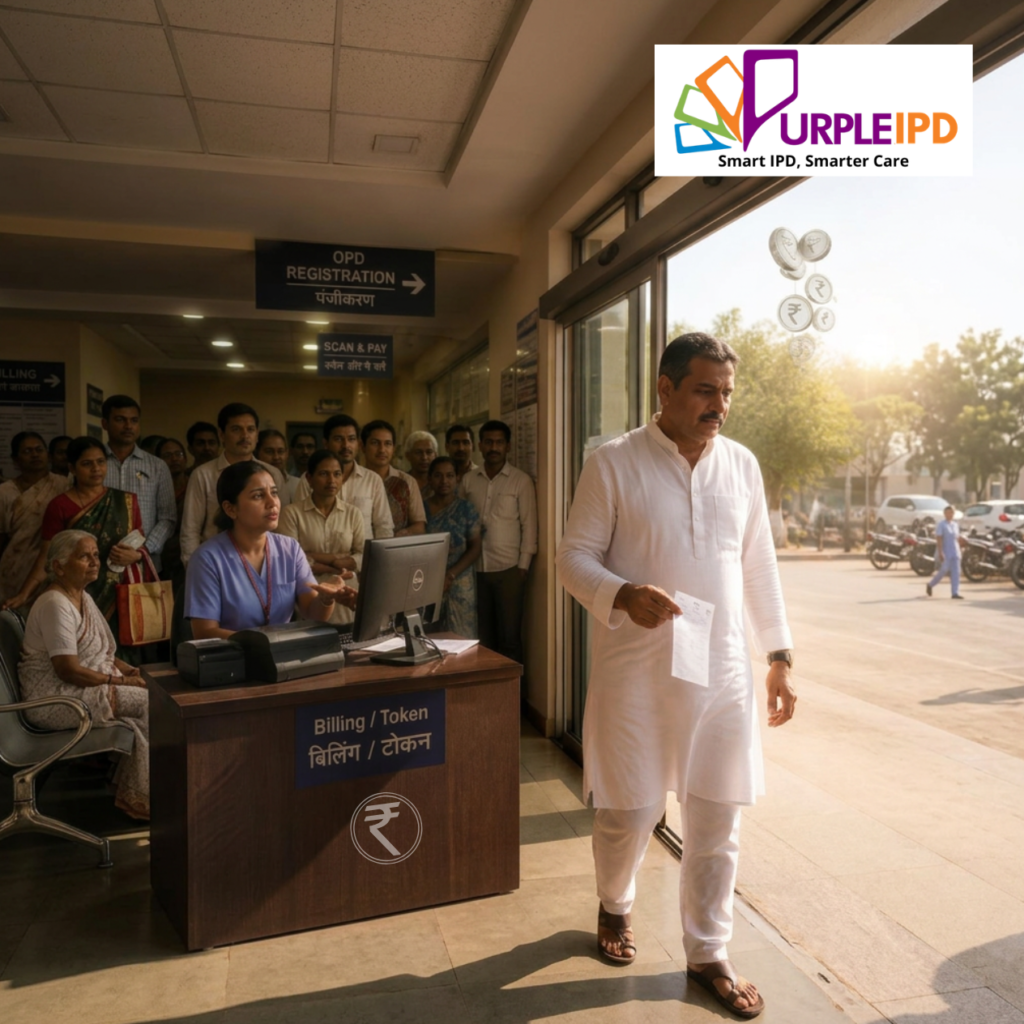
Here is how it happens every single day:
The paper RGHS workflow — where revenue leaks
Step 1 — RGHS patient registers
The patient presents their RGHS card. A Transaction ID (TID) is generated on the RGHS portal. The prescription for this patient must be written on a specific RGHS letterhead generated after the TID — not on the hospital’s standard letterhead, not on a blank sheet. Only on this page, for this patient, for this visit.
Step 2 — The OPD is running at full capacity
Your doctor is seeing 80–100 patients today. RGHS and non-RGHS patients in the same queue. For every RGHS patient, someone has to print the letterhead, bring it to the doctor before the consultation, collect the handwritten prescription afterwards. In a busy OPD, this coordination breaks down multiple times every day.
Step 3 — After consultation
The handwritten RGHS prescription has to be scanned or photographed, uploaded to the RGHS portal, and linked to the correct TID. This step requires staff time. In a busy OPD, it gets deferred — “we’ll do it after the rush.”
Step 4 — The patient leaves
The patient collects their prescription and walks out. The hospital intended to digitise and upload it. The prescription is sitting on a desk in a pile of papers. Staff are handling the next batch of patients. The RGHS portal never gets the upload. The claim is not filed. The hospital treated the patient, bore the cost, and earned nothing from RGHS.
The audit risk paper creates for honest hospitals
The Rajasthan government’s 2-year OPD slip audit is not looking only for fraud. It requires hospitals to demonstrate:
Paper RGHS prescriptions — handwritten, sometimes illegible, sometimes incomplete — fail multiple points on this checklist. Not because the hospital did anything wrong. Because paper cannot prove what happened, when it happened, and to which patient.
How PurpleEMR eliminates RGHS revenue leakage — from the first consultation
PurpleEMR is the only OPD software that makes RGHS documentation digital from the moment of consultation — not as a post-consultation scanning step. This is not an incremental improvement over the paper workflow. It eliminates the workflow failure entirely.
With PurpleEMR — RGHS digital workflow
Step 1 — RGHS patient registers
The patient presents their RGHS card. The TID is generated. PurpleEMR automatically loads the patient-specific RGHS letterhead — digitally mapped to that patient and that visit. No printing. No paper to carry to the doctor. The letterhead is on screen, ready.
Step 2 — The consultation
The RGHS patient enters the consultation. The doctor sees the digital RGHS letterhead on screen — with the TID embedded, the patient’s details pre-filled, the scheme parameters visible. The doctor writes the prescription directly on the digital letterhead. The prescription is digital from this moment. No handwriting. No paper. No scanning required.
Step 3 — Ambient scribing (optional)
PurpleEMR’s ambient scribing feature allows the doctor to speak naturally with the patient during consultation. The consultation note is generated from the conversation. The doctor reviews and approves in seconds. The prescription, symptoms, history, and clinical notes are complete — structured, searchable, audit-ready.
Step 4 — Patient leaves. Claim is already ready.
The prescription is already digital and linked to the TID. Staff process and submit it to the RGHS portal — with no scanning, no re-entry, no race against the patient walking out the door. Even if the patient leaves immediately after consultation, the claim documentation is complete in the system. Zero revenue leakage from patients leaving before digitisation.
| RGHS Step | Paper workflow | PurpleEMR |
|---|---|---|
| Letterhead | Printed, handed to doctor, collected after | Patient-mapped, loads on screen automatically |
| Prescription | Handwritten on paper letterhead | Digital from consultation — typed or dictated |
| After consultation | Scan paper, upload to portal manually | Staff submit from digital record — no scanning |
| If patient leaves early | Claim lost — 100% revenue leakage | Claim ready — prescription already in system |
| Audit readiness | Handwritten, potentially illegible, no audit trail | Complete, structured, timestamped, attributable |
| Mixed OPD queue | Extra steps per RGHS patient — slows queue | Same digital flow — no separate RGHS step |
RGHS IPD claims: why paper discharge files get rejected, and digital ones don’t
The RGHS OPD problem gets most of the attention because it’s visible — patients walk out, and claims are missed. But the RGHS IPD claim problem is equally expensive and less obvious.
An RGHS IPD claim requires a complete discharge file — nursing notes, medication administration records, investigation reports, surgical notes, consent forms, and a signed discharge summary. In a paper-based hospital, this file is assembled manually at discharge. Missing documents, illegible entries, or unsigned forms trigger claim queries and delays. Repeated queries put the hospital on the RGHS radar for audit.
|
Auto-validated EMRD
PurpleIPD’s discharge checklist validates that every required RGHS document is complete before the file locks. Consent forms, nursing notes, investigation reports — all verified before discharge is processed. |
AI-suggested discharge summary
The RGHS discharge summary is generated from clinical data entered during the stay. Complete medication history, investigation results, treatment progression — accurate and complete from day one. MO reviews and signs. |
|
Geotagged clinical photos
For surgical RGHS claims requiring procedure photographs, PurpleIPD captures photos with GPS tag and timestamp, permanently linked to the patient’s IPD record and ABHA. |
Full audit trail
Every entry is attributed to a specific user, role, and timestamp. When the RGHS AI audit system checks your hospital’s claim data, every entry is verifiable and traceable. |
RGHS, ABDM, and NABH — why all three require the same solution
RGHS-empanelled hospitals in Rajasthan are simultaneously managing three compliance requirements that all point to the same underlying need: digital documentation at the point of care.
| Requirement | What it demands | Paper status |
|---|---|---|
| RGHS OPD | Patient-specific letterhead, complete OPD slip, portal upload before patient leaves | Revenue leakage on every missed upload |
| RGHS IPD | Complete discharge file, geotagged photos, verifiable records for AI audit | Claim queries, delays, audit risk |
| ABDM M2 + M3 | Every clinical record digitally linked to ABHA in FHIR R4 format | Fails M2 and M3 — de-empanelment risk |
| NABH 6th Ed. | Complete IPD documentation, verifiable timestamps, full audit trail | Non-conformity — most common NABH failure |
PurpleEMR and PurpleIPD address all four simultaneously — because they are built on the same foundation: digital documentation created at the point of care, linked to the patient’s ABHA, structured for scheme claims, and verifiable for any audit. One system. Four compliance requirements. No paper in the middle.
Calculate your hospital’s RGHS leakage — then fix it
We’ll show you how PurpleEMR’s RGHS workflow eliminates revenue leakage from the first consultation. 20 minutes. No generic demo.
Book a Walkthrough →
💬 WhatsApp Us
For RGHS-empanelled hospitals in Jaipur, Jodhpur, Udaipur, Kota, Ajmer, Bikaner, and across Rajasthan
Related reading
- Paperless Hospital Software Rajasthan — ABDM, RGHS, and AB-PMJAY
- ABDM Compliance for Rajasthan Hospitals — IPD Guide
- How Paperless IPD Gets Insurance Claims Approved Faster
- NABH IPD Documentation Checklist
- How to Evaluate Any IPD/OPD Software Vendor in 2026