Every new hospital plans for beds, machines, and doctors. Very few plan for the thing that quietly fills the building: paper.
IPD files, case sheets, nursing charts, consent forms, printers, toner, steel racks, and a records room to hold it all. Most hospitals treat this as the cost of doing business.
Rayos Comprehensive Cancer Care in Anand chose paperless hospital software from day one, and skipped the stationery budget entirely.
Rayos has run on PurpleIPD since July 2026, without printing IPD stationery. On 4th October 2026, it was formally inaugurated in the presence of Gujarat minister Smt. Manisha Vakil and MLAs and MPs from Vadodara and across Gujarat, as a fully paperless hospital.
What paperless hospital software saves in trees
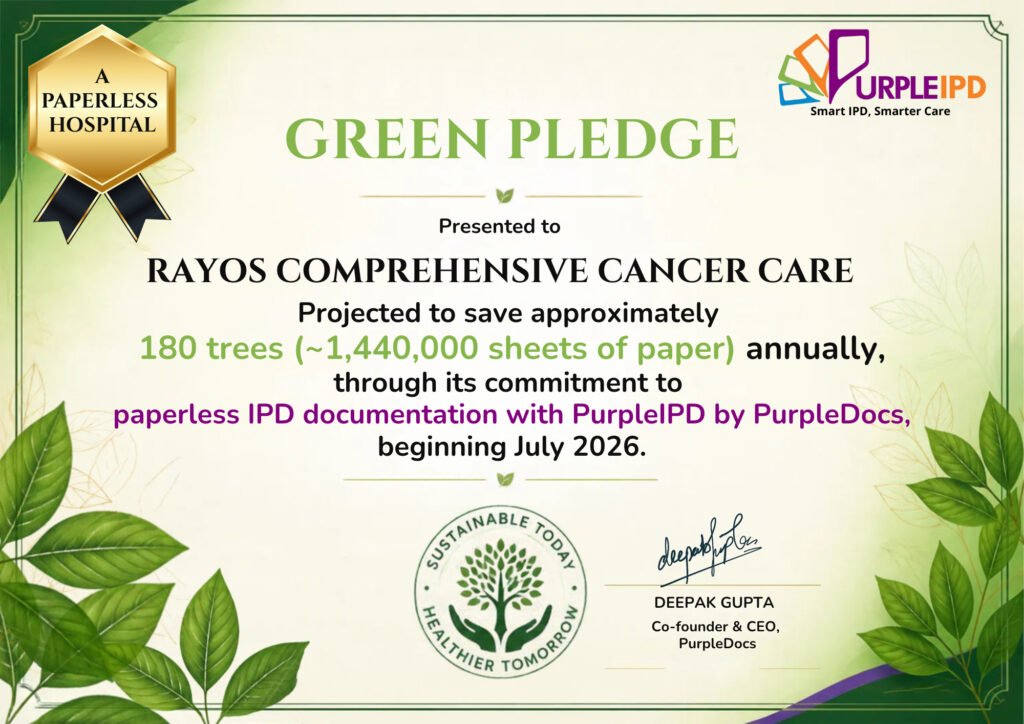
With PurpleIPD, Rayos is projected to save approximately 180 trees (about 14,40,000 sheets of paper) every year. These are trees that never become IPD files.
The carbon footprint a paperless hospital never creates
A printed IPD file carries a footprint long before a nurse writes on it. Wood is pulped, paper is made and transported, toner is manufactured, printers run, and finished files are stored for years. A hospital that never prints skips that whole chain. Fewer deliveries, less printing, and no records room to build, light, or maintain. Starting with a smaller footprint is far easier than shrinking one later.
What paper costs a hospital, and what paperless hospital software recovers
Paper looks cheap per page. It isn’t cheap per year. Here is what it costs a typical 100-bed hospital with 1,500 admissions a year, using our calculator’s assumptions (120-page IPD file, ₹0.85 per printed page, a ~150 sq ft records room, staff time at ₹90 an hour):
- Direct costs: about ₹2.8 lakh a year. Stationery and printing take ₹1.5 lakh, records room space ₹1.1 lakh, and pest control and upkeep about ₹18,000.
- Skilled staff time spent on paper: about ₹2.0 lakh a year. This includes file handling and retrieval, discharge record preparation, and TPA and insurance documentation.
- Capacity held back by slow discharges: an estimated ₹20 lakh a year. A discharge that is 4 hours faster frees beds for roughly 50 more patients.
That adds up to about ₹24.8 lakh every year, from a system that can be replaced. Going paperless is estimated to recover about ₹23.8 lakh in year 1, ₹71.5 lakh over 3 years, and ₹1.19 crore over 5 years (excluding ABHA incentives and scheme claim recovery).
An existing hospital has to unlearn this cost. A new hospital never has to start paying it.
Integrated hospital software: IPD, HIS and LIS working as one
Going paperless on its own isn’t the goal. A hospital that scans files into one system, runs the lab on another, and the pharmacy on a third has only moved its paper problem around.
Rayos runs on a fully integrated system: PurpleIPD, PurpleHIS and LIS working together as one. Lab reports reach the patient’s file without anyone re-entering them. What doctors prescribe and what the hospital stocks stay in step. OPD and IPD sit in the same record. A patient’s history is there when the doctor needs it, and a follow-up visit doesn’t start from a blank page.
The benefit is simple. Doctors and nurses type less and spend more time with patients. Nothing is written twice, and nothing is left in another department’s file. That is the difference between hospital software that digitises paper and hospital software that replaces it.
What paperless hospital software means for a cancer patient
This part is personal for us. When Deepak’s mother was being treated for cancer, every visit meant carrying a bag full of records. That bag is why we build what we build.
Cancer treatment is long and repeated: chemotherapy cycles, radiation sessions, follow-ups. At Rayos, patients returning for treatment don’t carry a folder. Their reports and history are already there at check-in. In an emergency, the doctor sees the full picture immediately.
A green pledge, honoured
We presented Rayos with a Green Pledge certificate recognising their commitment to paperless IPD documentation.
Evaluating hospital software for a new or existing hospital?
Before you finalise the stationery budget, see what paper would really cost you. Put your own numbers into our Hospital Stationery Cost Calculator, then talk to us about launching paperless and fully integrated from day one.