

A medical records department (MRD) is the hospital unit that creates, stores, protects, retrieves and releases the clinical file of every patient treated there. It assigns each patient a record number, checks that files are complete after discharge, codes diagnoses, and answers record requests from doctors, insurers and courts. In many Indian hospitals it also registers births and deaths. Think of it as the hospital’s memory and the single gate that every record request passes through.
This article covers why the department matters, what it does day to day, and how to run storage, retrieval and release with sensible controls. It ends with a comparison of paper and digital setups, so you can judge whether your records room helps your hospital or slows it down.
PurpleIPD, made by PurpleBits Infosystems, is built to replace paper IPD files in Indian hospitals, so the problems of the records room sit at the center of our work. The advice below applies whether your files sit on shelves or on tablets.
Why the medical records department matters
The medical records department matters because every clinical, financial and legal decision in a hospital rests on a record that must be complete, findable and trustworthy. When it works, nobody notices. When it fails, discharge, billing and audits all stall.
Who depends on the records
Many people use the same file for different reasons, and the MRD has to serve all of them without exposing the record to the wrong person.
- Treating doctors: past admissions, allergies and investigations for continuity of care.
- Billing and insurance desks: the documents that support claims from TPAs and government schemes.
- Quality and NABH coordinators: evidence that processes are followed.
- Patients and attendants: discharge summaries, reports and certificates.
- Courts and police: records in medico-legal cases.
- Researchers and administrators: data for studies and hospital statistics.
What a weak records room costs
A file that cannot be found delays treatment decisions and slows discharge, because the discharge summary, consent forms and investigation reports must all be assembled first. A file with missing signatures or forms invites TPA queries and delayed or rejected claims, which is revenue the hospital has already earned.
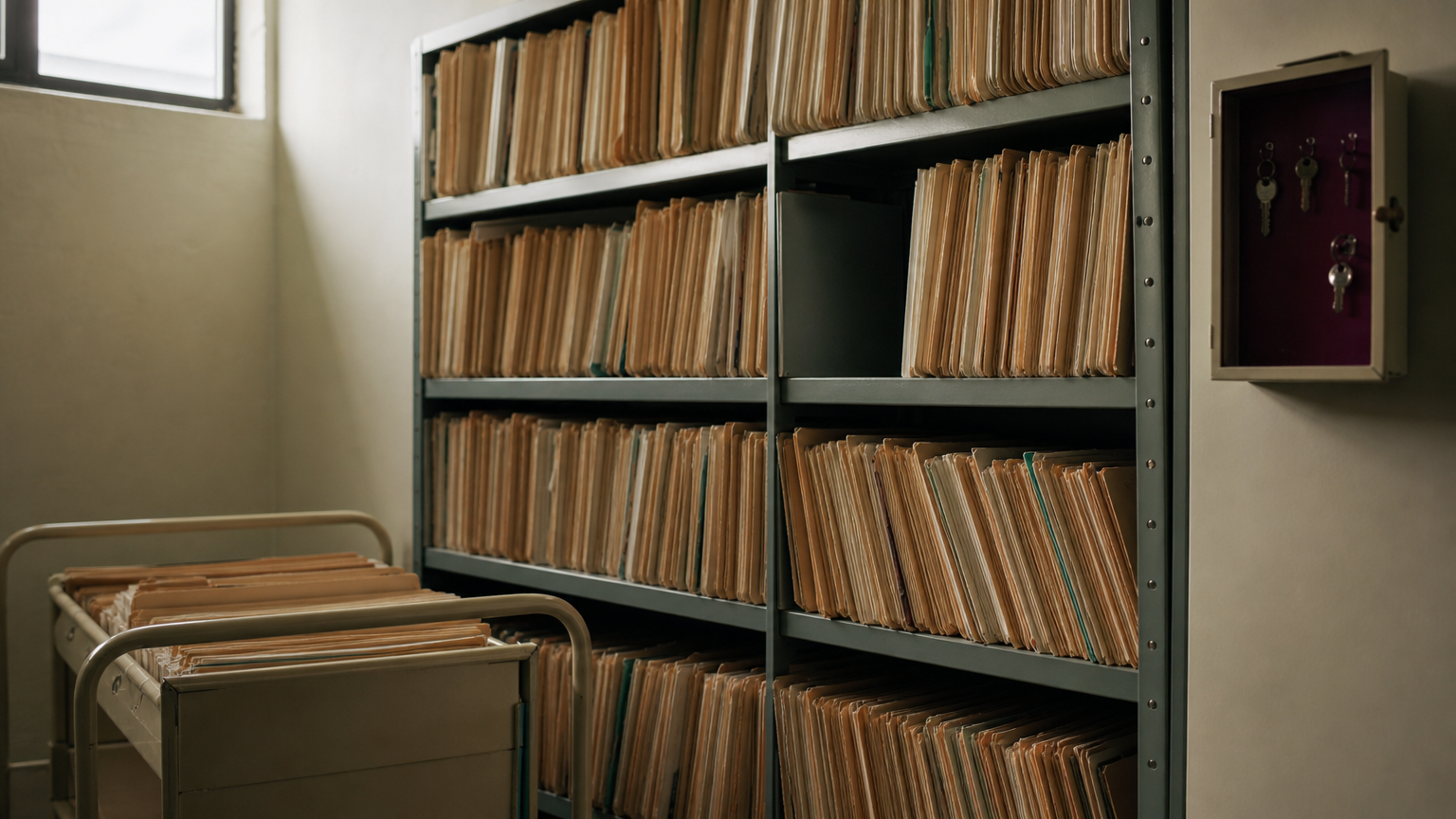
Paper adds direct costs too. You pay for printing, shelving, floor space and staff who spend their day carrying files. Audit preparation becomes a scramble to pull samples and discover what is missing.
A record you cannot find in minutes cannot help the patient, the claim or the audit.
What a medical records department does
The department’s work runs as a loop. It creates the record at admission, assembles and checks it after discharge, codes and analyzes it, files it, and serves requests against it. Each step has an owner and an output.
Core functions in order
The table lists the standard functions of an MRD, in the order a file meets them.
| Function | What happens | Why it matters |
|---|---|---|
| Registration and numbering | A unique record number is assigned and duplicates are checked | One patient, one identity |
| Assembly | Loose sheets are arranged in a fixed order after discharge | Every file reads the same way |
| Deficiency analysis | Missing signatures, consents or discharge summaries are flagged to doctors | Complete files before filing and claims |
| Coding and indexing | Diagnoses and procedures are coded (ICD) and indexed | Statistics, insurance and research |
| Storage and retrieval | Files are stored by number and tracked when issued | Fast, accountable access |
| Release of information | Copies go only to authorized requesters | Privacy and legal safety |
| Statistics and vital events | Census and mortality reports; birth and death registration where assigned | Planning and legal certificates |
Who works in the department
A medical records officer or MRD in-charge usually leads the department, supported by record technicians, clerks and coders. The head typically reports to the medical superintendent or the quality head. Everyone in the room carries a duty of confidentiality, and access to the room itself should be limited to named staff.
Responsibility is shared with clinicians. The MRD owns the file, but doctors and nurses own what is written in it. A deficiency list only works when doctors complete their notes within a fixed number of days, and the department needs backing from management to enforce that.
The MRD owns the file, but clinicians own the content, and both must finish their part before a record is closed.
How to store, retrieve and release patient records
Good record handling rests on three written procedures: a filing system that makes any file findable by number, a tracking system that shows where every file is, and a release protocol that says who may receive what. Write each one down and train every shift on it. Inpatient files normally live in the MRD, while outpatient records may be kept in the OPD, as the WHO medical records manual describes.
Storing records: numbering, filing and retention
Use terminal digit filing if you hold many files. You split the record number into pairs and file by the last pair first. Record 482317 becomes 48-23-17 and goes to section 17, then sub-section 23, then position 48. Files spread evenly across shelves, and misfiling falls because staff only handle one pair at a time.
Retention needs a written policy. Indian Medical Council regulations from 2002 ask physicians to keep indoor records for three years from the start of treatment. Many hospitals keep them much longer, and medico-legal cases usually stay for good. NABH expects a defined retention policy, so confirm current rules with your legal adviser. Shelving should be away from damp, pests and fire risk.
Retrieving records without losing files
Every file that leaves its shelf needs a trace. This sequence works for most hospitals:
- The requester submits a requisition with the record number, patient name and purpose.
- MRD staff pull the file and put an out-guide card or log entry in its slot.
- The log records who took it, when, where it is going and the expected return time.
- The ward or department signs on receipt.
- On return, staff check that the file is complete and refile it.
- A daily reconciliation lists overdue files, and someone chases each one.
Releasing records safely
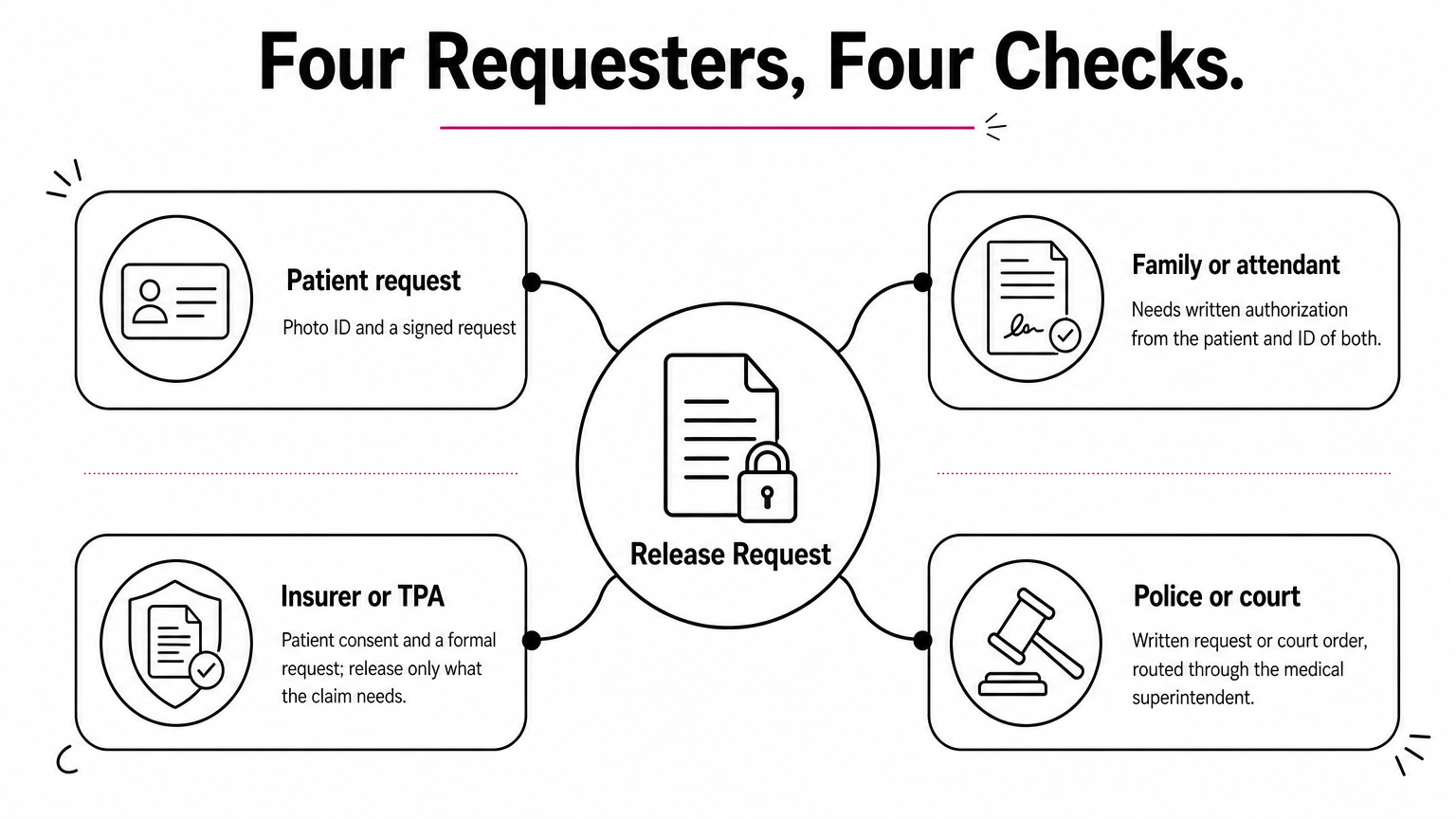
Release is the riskiest step because a mistake exposes a patient’s private information. Check identity and authority before anything leaves the room.
| Requester | What to check before release |
|---|---|
| Patient | Photo ID and a signed request |
| Family member or attendant | Written authorization from the patient and ID of both; proof of relationship if the patient has died or cannot consent |
| Insurer or TPA | Patient’s consent and a formal request; release only what the claim needs |
| Police or court | Written request or court order, routed through the medical superintendent |
Give photocopies, not originals, unless a court orders otherwise. The same 2002 regulations expect copies to be provided within 72 hours of a valid request, so log the request time. India’s Digital Personal Data Protection Act, 2023 adds a legal duty to protect personal data, which makes a release log more important.
Release photocopies, not originals, and log who asked, who approved and what left the room.
Moving the medical records department off paper
A digital medical records department keeps the same functions but removes the physical handling. Files are created, checked and retrieved on screen, and every access is logged automatically. The question is no longer whether to keep an MRD but how much of its work a system can take over.
Paper and digital compared
| Task | Paper MRD | Digital MRD |
|---|---|---|
| Finding a file | Walk to the shelf; a misplaced file can be lost for hours | Search by name or number |
| Completeness check | Manual, after discharge | Missing forms flagged during the stay |
| Access control | Room keys and trust | Role-based access with a log of every view and change |
| Several users | One file, one place at a time | Departments can work on the same record together |
| Running cost | Printing, shelving, floor space | Tablets, server and support |
| Audit preparation | Pull sample files by hand | Check compliance status on screen |
Where PurpleIPD fits
PurpleIPD is a documentation layer that sits alongside your HIS or HIMS rather than replacing it. Staff write with a stylus on digitized versions of your own forms on Android tablets, so the workflow stays familiar. An audit trail tracks every change, login and access, and the system flags missing forms before discharge, which is the deficiency check moved from the records room to the ward. Video consent, role-based access, on-premises storage and ABDM and HCX connectivity cover release and security.
Results vary by hospital, but PurpleIPD reports up to a 70% reduction in stationery costs, and VIMS Hospital cut discharge turnaround by 1.5 hours. Whichever system you evaluate, check that it supports your numbering, retention and release procedures instead of forcing you to rewrite them.
Going digital does not remove the MRD; it moves its checks from after discharge to during the stay.
Putting your records room in order
A medical records department exists to make sure the right record is complete, findable and shared only with the right people. It does that through a clear loop: numbering, assembly, deficiency checks, coding, tracked storage and controlled release. Whatever your size, write the procedures down, assign an owner to each step, and measure how long it takes to find a file and close a discharge.
If your team still spends hours chasing paper, the quickest gains usually come from moving documentation off paper and onto tablets while keeping your existing forms. You can book a demo of PurpleIPD to see how a paperless IPD workflow would change the work of your records room.
