Healthcare electronic medical records are the digital version of a patient’s chart inside one hospital or clinic. They hold diagnoses, medical history, medicines, vitals, test results, progress notes and consent forms in one system instead of paper files. In a hospital, doctors, nurses, the lab and the billing desk all read from and write to the same record.
This guide goes beyond the definition. You will see why electronic medical records for hospitals matter, how to move a hospital from paper to digital step by step, which government programs apply in Gujarat, and which kinds of software you can choose from.
PurpleIPD is built by PurpleBits Infosystems in Vadodara. We work every day with the paper IPD files, case sheets and registers that Indian hospitals are trying to leave behind. We focus on inpatient documentation, so we will also tell you where that fits in an EMR plan and where it does not.
Why electronic medical records matter for hospitals
Hospitals adopt electronic medical records because paper slows care, costs money to print and store, and makes audits and insurance claims harder to defend. The gains show up at the bedside first and in the accounts department soon after.
Safer, faster care at the bedside
A paper file can be in only one place at a time. When a nurse has the case sheet, the doctor on rounds waits. In a digital record, doctors, nurses and the lab see the same chart at once, and every entry carries a time and a name. Illegible handwriting stops being a risk, and a missing form can be flagged before it becomes a gap.

Retrieval changes too. Pulling an old admission from an MRD room takes effort, while a digital system finds past records in seconds. That matters most in emergencies and for patients who return with chronic conditions.
Lower costs, cleaner claims and easier audits
Paper has a running cost: printing, file covers, registers, storage space and the staff who manage the MRD room. Going digital cuts stationery and storage costs. Hospitals using PurpleIPD have seen up to a 70% reduction in stationery costs, and VIMS Hospital cut its discharge turnaround by 1.5 hours.
Claims and audits depend on complete documents. TPAs and PM-JAY reviewers query missing consent or incomplete notes. NABH assessors want records that are complete, traceable and timestamped. An audit trail that logs every change, login and access gives you that evidence without a hunt through files.
Every missing document in a file is either a delayed discharge or a delayed claim.
EMR, EHR and HIS: how they differ
People use these terms loosely, but they describe different things. The table sets them side by side.
| Term | What it is | Scope | Typical use |
|---|---|---|---|
| EMR | Digital patient chart kept by one hospital or clinic | One facility | Doctor notes, orders and results during an admission |
| EHR | Patient record built to move between providers | Many facilities | Referral to another hospital with full history |
| HIS or HIMS | Hospital operations software, often with an EMR module | Whole hospital | Registration, billing, pharmacy, inventory |
| PHR | Record held by the patient, often in a mobile app | Patient | Viewing reports and medicine reminders |
Most hospitals need both an operations system and a clinical record. The gap between the two is usually where paper survives.
How to adopt an EMR system in your hospital
To adopt an EMR, map your paper workflow, choose a system that fits it, pilot in one ward, and then roll out form by form. Plan for weeks, not days. For a documentation layer such as PurpleIPD, most hospitals are up and running in 6 to 8 weeks.
Six steps from paper to digital
Follow this order and you avoid most rework:
- List every paper form, register and file. Include admission notes, nursing charts, medication records, consent forms, discharge summaries and the MRD register.
- Decide your scope. Choose between replacing your whole HIS, adding an EMR module, or adding a documentation layer on top of the HIS you already run.
- Write down your compliance needs. Cover NABH, ABDM, PM-JAY and HCX requirements, and data protection under the DPDP Act.
- Decide where data lives and on what devices. Choose on-premise or cloud, and check whether your existing tablets or PCs can be reused.
- Pilot in one ward. An ICU or a single floor shows you the real problems within a few weeks.
- Train every shift, then retire paper. Move form by form, not all at once.
A worked example for a mid-sized hospital
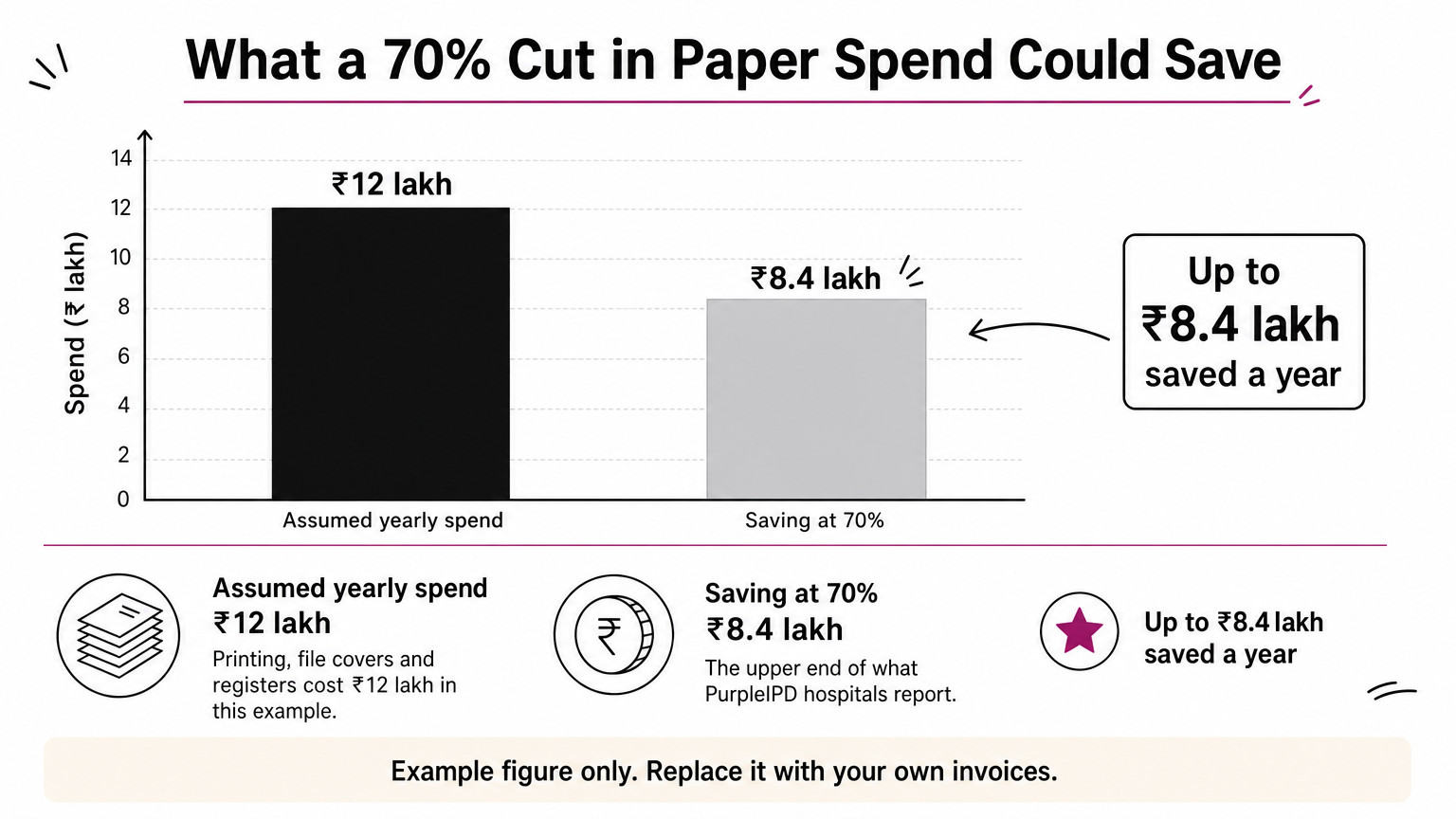
Suppose a hospital spends ₹12 lakh a year on printing, file covers and registers. That figure is an assumption, so replace it with your own invoices. A 70% reduction, which is the upper end of what PurpleIPD hospitals report, would save up to ₹8.4 lakh a year, before you count MRD space and staff time.
Run the same exercise for your discharge process. Note how many hours pass between the doctor’s decision and the patient leaving. That gap is where electronic medical records for hospitals pay back fastest.
Getting staff to use it
Adoption fails when the new system forces a new way of working. Choose software that digitises your existing forms, so nurses and doctors see familiar layouts. Tools that let staff write with a stylus as on paper, with keyboard entry as an option, reduce resistance.
Insist on training for each shift and a named support contact. Staff who feel the system helps them chart faster will stop reaching for paper.
A system that copies your paper workflow gets used, and a system that replaces it gets worked around.
Government programs behind EMR adoption in Gujarat
The national framework for healthcare electronic medical records is the Ayushman Bharat Digital Mission (ABDM). Gujarat’s Health and Family Welfare Department adds state systems, and the NIC’s e-Hospital serves government facilities. Private hospitals are not forced onto these, but your software should connect to them.
ABDM and ABHA
ABDM lets patients create an ABHA number and link their health records to it. Hospitals register in the Health Facility Registry, and ABDM-enabled software can create records and share them with patient consent. The Health Claims Exchange (HCX) extends this to insurance claims.

ABDM has also run incentive schemes for facilities that link patient records to ABHA. Check the current terms before you budget around them. Ask any vendor which ABDM milestones its software supports today.
e-Hospital and Gujarat’s state systems
e-Hospital is an NIC solution for government hospitals. It covers patient care, laboratory services, medical records and online registration, which has been available since 2015. eSanjeevani provides government telemedicine, and a Government of Gujarat investment profile lists state tools such as TeCHO+ and e-Mamta for community health workers and mother and child tracking.
If you run a private hospital in Ahmedabad, Surat, Rajkot or Vadodara, these systems matter mainly because your patients may already hold ABHA numbers and records created through them.
Data protection and record-keeping rules
The Digital Personal Data Protection Act, 2023 governs how you store and share patient data. Medical Council regulations have long required doctors to maintain indoor patient records for at least three years. NABH adds its own standards for medical records. Confirm current obligations with your legal adviser.
Choose software that stores data where you can protect it and show who accessed it.
Choosing EMR software for hospitals in Gujarat
Software for healthcare electronic medical records falls into four types. The right one depends on whether you need to replace your HIS or fill the gap it leaves in clinical documentation.
Four types of options compared
| Option | Best for | Strength | Watch out for |
|---|---|---|---|
| Government e-Hospital | Government hospitals | Public platform, no vendor selection | Built for public facilities |
| Full HIS or HIMS with EMR module | Hospitals replacing all software | Registration, billing, pharmacy and records in one system | Long rollout, and bedside documentation may stay on paper |
| Standalone EMR | Clinics and OPD-heavy practices | Fast and light to set up | Limited depth for inpatient wards |
| Inpatient documentation layer | Hospitals that have a HIS but still use paper IPD files | Digitises existing forms, no change to your HIS | Not a replacement for billing or pharmacy software |
Questions to ask every vendor
Put these to each shortlisted vendor in writing:
- Which ABDM, HCX, PM-JAY and NABH requirements does the software support today?
- Where is patient data stored, and how is it encrypted and backed up?
- Does it keep an audit trail of every change, login and access?
- How does it integrate with your HIMS, lab systems and billing software?
- Who configures your forms, and how long does onboarding take?
- Is pricing based on beds, devices or users?
- Can you call a hospital that went live with it?
Where PurpleIPD fits
PurpleIPD is paperless IPD software that sits alongside your HIS instead of replacing it. It runs on standard Android tablets with a Samsung or Lenovo stylus, and it digitises your hospital’s actual paper forms. A form builder covers anything new.
It runs on the hospital LAN with no internet dependency, keeps data on-premise and backs it up to the cloud. Other features include video consent recording, compliance flags for missing forms and role-based access control. It connects with ABDM and HCX, and pricing depends on the number of tablets or beds. If you need billing, pharmacy and inventory in one package, you still need a HIS or HIMS alongside it.
PurpleIPD handles the bedside record, and your HIS keeps handling the business of the hospital.
Where to start with your own EMR
Healthcare electronic medical records replace paper charts with a digital record that every authorised clinician can read at once. The payoff is faster discharges, cleaner claims, easier NABH audits and lower stationery spend. Start by listing your paper forms, set your scope, check ABDM and data protection needs, and pilot in one ward.
If your hospital already has a HIS but inpatient files are still on paper, that is the gap to close first. You can book a PurpleIPD demo to see your own forms digitised and judge whether it fits your wards.