The best cloud-based hospital management software for a hospital in Gujarat covers OPD, IPD, billing, pharmacy, lab and EMR, supports ABDM, and fits your bed count and internet reliability. Of the four options below, Doctors App suits cloud-first hospitals and multi-branch groups that want AI-assisted notes. Tapti HMIS suits nursing homes and small hospitals that want published prices. SoftClinic GenX suits hospitals that want one Ahmedabad-built system with regional language support. eMedHub suits Ahmedabad hospitals that want a long module list.
The difficulty is that every vendor lists the same modules, so the feature sheets look identical. The real differences sit in where your data is hosted, what happens when the internet drops, which ABDM and PMJAY work the system handles, whether the price is public, and how long go-live takes. Those are the points compared here for hospitals in Ahmedabad, Surat, Vadodara and Rajkot.
PurpleIPD is made by PurpleBits Infosystems in Vadodara. It is paperless IPD documentation that runs next to a hospital’s HIS, not a cloud management system, so it is not ranked below. That gives us a clear view of where management software stops and ward documentation starts. Each pick follows the same pattern: what it covers, who it suits, and what pricing and rollout look like. A shortlist guide closes the list.
1. Doctors App
Doctors App is a cloud-hosted HMIS that puts OPD, IPD, billing, pharmacy, lab, radiology and teleconsultation on one platform. It is the most cloud-native option here, and it markets itself to Gujarat hospitals on ABDM compliance and AI documentation.
What it covers
Staff reach the system from desktops, laptops, tablets, Android phones and iPhones, which is the main practical gain of a cloud system. Two AI tools set it apart. AI voice prescription turns speech into prescriptions, and an AI medical scribe turns consultations into notes.
- ABHA creation and verification, plus PMJAY support
- Cloud EMR and EHR with prescriptions and lab reports
- GST invoicing and pharmacy batch and expiry tracking
- Multi-hospital dashboard with separate access controls per branch
- AWS hosting, encrypted storage, automatic backups, audit logs and role-based access
Doctors App is the strongest pick when cloud access and AI-assisted notes matter more than on-premise control.
Who it suits
It suits multi-specialty hospitals, nursing homes and hospital groups that want one dashboard across branches. Doctors who spend long hours typing notes gain the most from the AI features.
A cloud-only system depends on your connection. Ask what staff can do at the bedside if the link at your site drops, and test voice prescription in the language your doctors actually dictate in.
Pricing and rollout
Prices and go-live timelines are not published, so the quote has to come from the vendor. A free live demo is offered before implementation. Ask for these in writing:
- A module-wise quote that includes support, storage and the AI features
- A go-live date for your bed count
- A data export option if you leave
2. Tapti HMIS
Tapti HMIS is built by Tapti Technology in Surat. It stands out because it publishes its starting prices, which is rare for hospital software.
What it covers
It covers OPD, IPD, billing, lab, pharmacy, surgery and OT, inventory, and mediclaim with TPA workflows. Billing is GST-ready with HSN codes, and invoice numbers follow the April to March financial year. Permissions go down to view, add, edit and delete per screen.
On compliance, it is integrated with ABDM milestones M1, M2 and M3. For PMJAY-MA it keeps the clinical evidence and invoice in one place, but it does not submit claims on the government portal. Your billing desk still files those.
Tapti is the easiest option to budget for, because its starting prices are public.
Who it suits
It suits nursing homes and small to mid-size hospitals that want predictable costs. Insurance-heavy hospitals also fit, since cashless files are tracked per admission. The team is in Surat, so on-site training in Gujarat is part of the offer.
Pricing and rollout
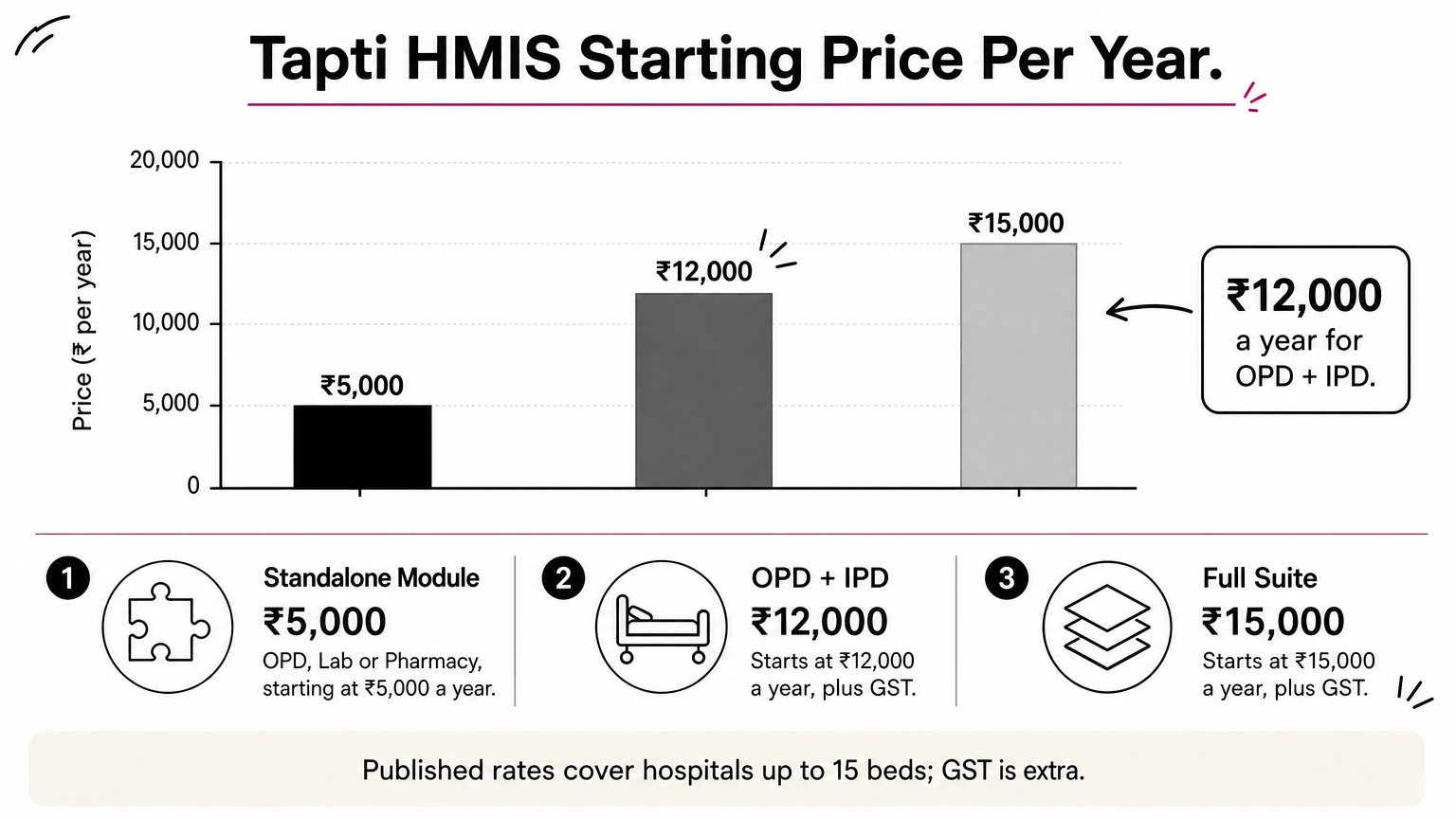
Published rates cover hospitals up to 15 beds, with up to 3 users on a standalone module, and GST is extra. Larger hospitals get a quote, and above 100 beds it is custom.
| Package | Starting price per year |
|---|---|
| One standalone module (OPD, Lab or Pharmacy) | ₹5,000 |
| OPD + IPD | ₹12,000 |
| Full Suite | ₹15,000 |
A 12-bed nursing home on OPD + IPD would start at ₹12,000 a year plus GST, or ₹36,000 over three years before GST. OPD-only setups go live in 2 to 4 weeks and the Full Suite in 4 to 8 weeks. Deployment is cloud with daily backups, or on-premise.
3. SoftClinic GenX
SoftClinic GenX comes from JVS Technologies in Ahmedabad. It is a full hospital management system that you can run on the cloud or on your own servers.
What it covers
It brings registration, OPD, IPD, wards, operation theatre, billing, insurance and TPA claims, inventory, pharmacy, lab and EMR into one connected system. Reporting and analytics come with it. The interface supports regional languages, which helps front-desk staff and patients across Gujarat.
If you want one vendor for the whole hospital, SoftClinic GenX is the most complete single-system option here.
Who it suits
It suits hospitals that want to replace several separate tools with one product, from a single-doctor clinic to a multi-specialty hospital. The vendor says it scales as you grow.
The cloud or on-premise choice helps if your management is undecided about hosting. You can compare both quotes from the same vendor.
Pricing and rollout
Prices are not published, so you get a quote through a free demo against your own workflow. The vendor states 24/7 technical support. Ask for a written quote split by module, with support and updates itemized, and confirm the ABDM scope in that demo.
4. eMedHub
eMedHub is cloud-based hospital management software (HIMS and EHR) for hospitals and clinics in Ahmedabad. The vendor describes it as ABDM-verified and NABH-ready, with more than 23 modules.
What it covers
The module count is the headline. A long list means departments beyond OPD, IPD and billing can be switched on later. Check which modules sit in the base price and which are add-ons, because a list of 23 only helps if you can use the ones you need.
eMedHub suits hospitals that want room to add departments, provided the base package covers today’s needs.
Who it suits
It suits Ahmedabad hospitals and clinics that want a local cloud vendor with a broad module list. Clinics that may grow into a hospital can start small and add modules.
Pricing and rollout
Treat price and go-live as open questions. Ask for a written quote and a go-live date tied to your bed count. Then ask for a demo on your own billing cases, including a TPA admission and a pharmacy return.
How to shortlist a cloud system before the demo
Shortlist two vendors, not four. Run both through the same questions, the same test cases and the same written-quote request. A cloud based system should win on answers, not on feature count.
Questions to ask every vendor
Feature sheets will not separate these products. These questions will, and the answers should come in writing.
- Where is the data hosted, and who owns it?
- What can staff do when the internet drops?
- Which ABDM milestones are live today, not planned?
- Does the system submit PMJAY claims, or only store the evidence?
- How does it handle consent and breach duties under the DPDP Act, 2023?
- Can you export all your data if you leave?
A cloud system is only as good as its answers on hosting, offline downtime and ABDM scope.
Cloud, on-premise or both
Cloud suits hospitals that want no server room and vendor-managed backups and updates. The trade-off is that you depend on your connection and your data sits with the vendor. Tapti and SoftClinic offer both models, so you can price each.
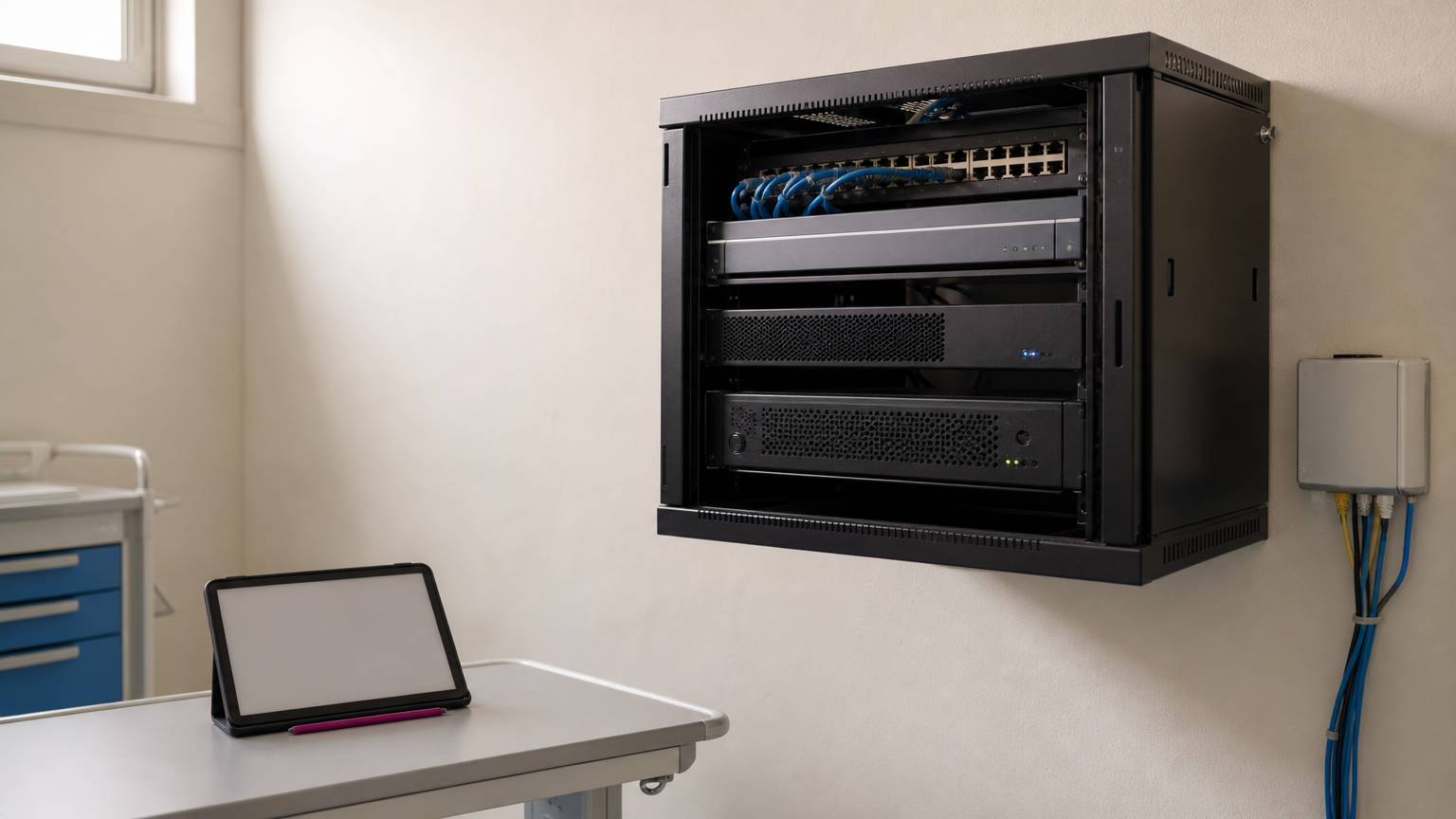
PurpleIPD fits differently. It is not a management system. It runs on the hospital LAN on standard Android tablets and digitises your existing paper forms, so your wards go paperless while your HMS keeps billing, pharmacy and registration. Setup takes about 6 to 8 weeks, and it connects with ABDM and HCX.
Side-by-side summary
| Vendor | Hosting | Compliance claims | Price visibility |
|---|---|---|---|
| Doctors App | Cloud on AWS | ABHA, ABDM-compliant workflows, PMJAY support | Not published |
| Tapti HMIS | Cloud or on-premise | ABDM M1 to M3 | Published from ₹5,000 a year |
| SoftClinic GenX | Cloud or on-premise | Confirm ABDM scope in demo | Not published |
| eMedHub | Cloud | ABDM-verified, NABH-ready | Confirm in demo |
Other vendors such as MocDoc, Medical365 and Softpital also market cloud systems in Ahmedabad and across Gujarat. Put them through the same questions if your shortlist needs more names.
Picking your shortlist
Pick the system that answers your hosting, offline and ABDM questions in writing, then check the price and go-live date. Doctors App leads on cloud access and AI notes, Tapti on public pricing, SoftClinic GenX on single-vendor scope, and eMedHub on module breadth.
A management system rarely settles what happens on the ward. If your inpatient files are still on paper after you choose one, book a PurpleIPD demo and see paperless IPD running on your own case sheets.