ABDM & Hospital Operations
The NCR hospital problem: digital HIS, paper wards, double the work
Delhi NCR has the highest density of NABH-accredited hospitals in India. Over 112 hospitals are CGHS empanelled in Delhi alone, and 79 of them hold NABH accreditation. This market runs on quality signals — accreditation, empanelment, insurance tie-ups, and consultant reputation.
Every hospital in this market has invested in a HIS. However, that investment solved the administrative layer — not the clinical documentation layer. Here is what a typical day looks like in an NCR hospital that has a fully functional HIS.
A typical NCR hospital today
6:00 AM — Nursing shift change
The night nurse hands over a stack of paper files. Vitals recorded on printed charts. Medication administration records filled by hand. One file is missing — it is with radiology for the last three hours. The morning nurse begins her round without complete patient information.
9:30 AM — Consultant’s round
A visiting consultant arrives. He practises at three hospitals across Gurgaon and South Delhi. At one hospital, he opens patient records on a tablet. At yours, a junior resident hands him a paper file. He scribbles progress notes. After the round, the resident sits at a desktop for 90 minutes, re-entering everything into the HIS. The HIS timestamp says 11:15 AM. The observation happened at 9:35 AM.
2:00 PM — CGHS patient discharge
The HIS generates a discharge summary. It gets printed. A clerk assembles the paper file — printed treatment charts, printed investigation reports, printed consent forms, handwritten nursing notes. The CGHS claim requires complete documentation. One missing consent form means the claim gets delayed. Another 30 pages go to MRD storage.
4:00 PM — NABH surveillance audit
The quality team needs 50 patient files for the NABH assessor. Three have missing consent forms. Two have unsigned medication charts. One file is misfiled. Retrieval takes 20 minutes per file. The assessor notes it as a non-conformity under CRE — the most common documentation failure in Indian hospitals.
Why paperless hospital software in Delhi NCR matters more than anywhere else
The double documentation problem exists across India. But in Delhi NCR, four factors make it uniquely expensive.
1. MRD storage costs more than clinical space
Commercial real estate in Gurgaon runs ₹8,000–₹20,000 per sqft. A 400 sqft MRD room costs ₹4–5 lakhs per year just in rent — before you add filing cabinets, retrieval staff, and maintenance. In South Delhi and Noida, the numbers are similar or worse. That is clinical space — procedure rooms, consulting rooms, recovery bays — being used to store paper that nobody accesses until an audit or a returning patient.
2. Visiting consultants compare you to the hospital across the road
NCR runs on visiting consultants. A senior cardiologist or orthopaedic surgeon practises at two to four hospitals. At the hospital with paperless hospital software, the consultant opens a tablet and sees the patient’s complete record instantly. At yours, a resident fetches the paper file. If the file is with another department, the consultant waits. Consultants bring patients. Consultants prefer the hospital that respects their time.
3. CGHS and ECHS claims require complete documentation
Over 112 hospitals in Delhi are CGHS empanelled. CGHS and ECHS are massive revenue channels for NCR hospitals — central government employees, pensioners, and ex-servicemen. In December 2025, the government cancelled all existing empanelment agreements and required hospitals to re-apply with new digital documentation. Claims require complete, verifiable patient records. A missing consent form, an unsigned medication chart, or a delayed discharge summary means a delayed or rejected claim. Paper workflows produce exactly these gaps.
4. NABH 6th Edition is stricter on documentation
The NABH 6th Edition standards contain 651+ objective elements. The most common non-conformity across Indian hospitals remains incomplete IPD documentation — missing entries, unsigned forms, and inconsistent timestamps. Every paper-based ward is a documentation risk during surveillance audits. NCR hospitals pursuing or maintaining NABH accreditation cannot afford these findings.
The real numbers: what double documentation costs an NCR hospital
Beyond these visible costs, there are risks:
What truly paperless hospital software delivers in a Delhi NCR ward
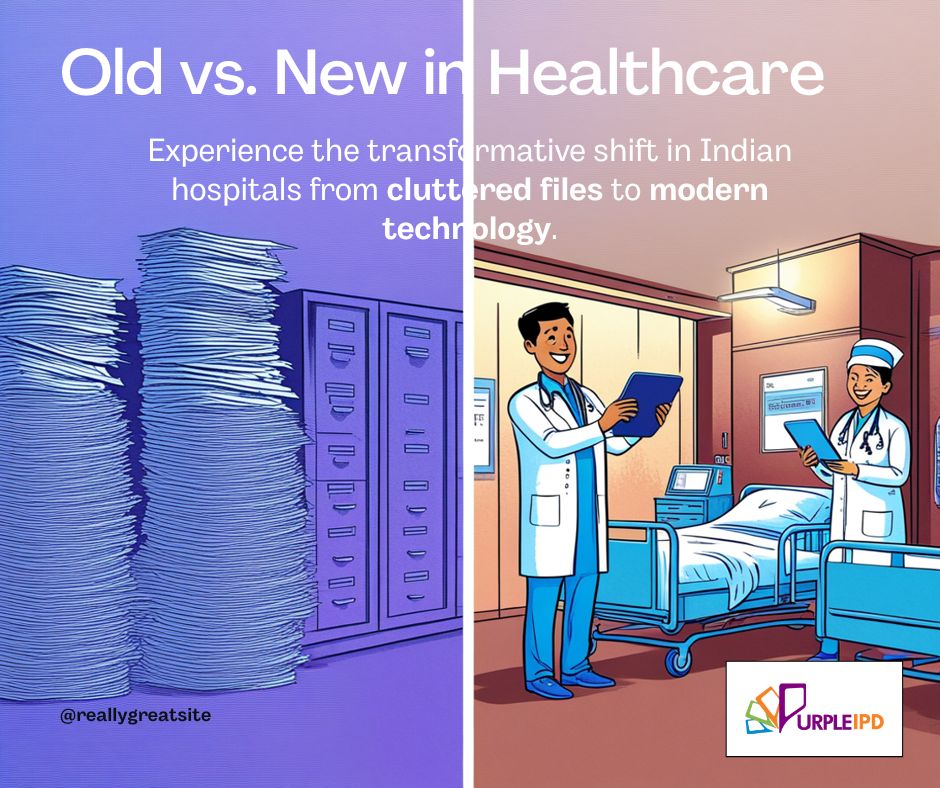
The fix is not a better HIS module. It is eliminating the gap between where care happens and where data is recorded. When a nurse documents vitals on a tablet at the bedside — not on paper first and HIS later — the double workflow disappears.
Same hospital. Same ward. Same morning. But now with PurpleIPD running alongside your existing HIS.
With PurpleIPD
6:00 AM — Shift change
The morning nurse picks up a tablet. Every patient’s record is live — overnight vitals, pending medication, doctor’s orders, alerts. No paper handover. No missing files. She begins her round immediately.
9:30 AM — Consultant’s round
The visiting consultant opens the patient record on the bedside tablet. Progress notes go in during the examination — timestamped at 9:34 AM because that is when it happened. No resident re-entering data later. The experience matches his other hospital — the one that already runs paperless hospital software. He no longer has a reason to prefer that facility over yours.
10:15 AM — Medication administration
The nurse records administration on the tablet the moment it happens. Timestamped at 10:15 AM. Not 4:00 PM when the shift ends. Simultaneously — the lab uploads results, pharmacy verifies orders, billing sees updated procedures. No department waits for a physical file.
2:00 PM — CGHS discharge
The discharge summary auto-generates from data already in the system. The EMRD checklist validates: all consents signed digitally? All nursing notes complete? All medication charts reconciled? The file locks. Nothing is printed. Nothing is filed. The CGHS claim goes out with complete documentation. No delays.
4:00 PM — NABH audit
Fifty records pulled on screen in 30 seconds. Every entry is attributed to a specific person, role, and timestamp. Zero missing files. Zero non-conformities on documentation. The MRD storage room? Convert it to a consultation bay. It earns revenue now.
Legacy paper records: the gap even digital hospitals carry
Even hospitals that go paperless in IPD still have years of patient records in physical storage from before the HIS was installed. A patient returning after a knee surgery two years ago has a history that sits in a box in MRD. The orthopaedic surgeon either waits 20 minutes for retrieval or proceeds without a complete history.
In NCR, where hospitals compete on clinical quality and consultant experience, this gap matters. PurpleDocs Digitisation closes it. Over 2 crore patient records digitised across 20+ Indian cities in 15 years. Your legacy paper records — old OPD cards, discharge summaries, investigation reports, surgical notes — digitised, indexed by patient ID, and accessible on screen when the patient walks in.
No other hospital software vendor in India offers paperless hospital software and legacy records digitisation as one connected service. PurpleDocs does — and has for 15 years.
PurpleDocs: Complete paperless hospital software for Delhi NCR hospitals
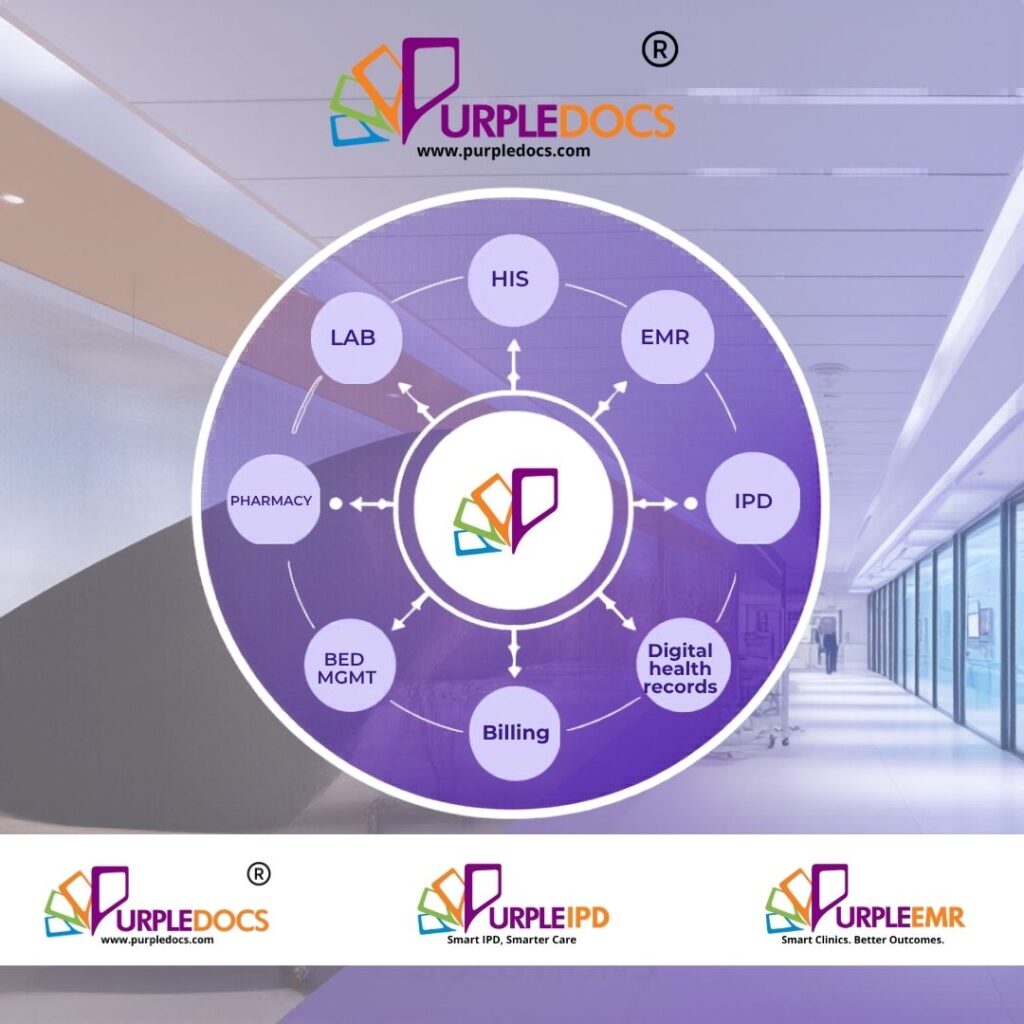
PurpleDocs is not a replacement for your HIS. It completes what your HIS started — with four products connected under one patient UHID.
PurpleHMIS — Hospital Operations
For hospitals that want the full stack. ABDM certified. Deploys on-premise.
- Patient registration, billing, pharmacy, lab integration, bed management
- ABHA registration and verification at admission
- Insurance claims with HCX — including CGHS and ECHS package rate mapping
PurpleEMR — OPD Consultations
Connected to PurpleIPD through one UHID — prescriptions flow into the IPD record automatically at admission.
- Digital prescriptions on your existing letterhead
- Queue management, follow-up scheduling, care plan templates
- Visiting consultant access — records available across OPD and IPD
PurpleIPD — Truly Paperless IPD
Records created at the bedside on tablets during rounds — not entered at a desktop after rounds.
- Real-time documentation — vitals, progress notes, orders entered during care
- Live medication records — timestamped at the moment of administration
- Parallel access — nursing, pharmacy, lab, billing, MRD work on the same record simultaneously
- Digital consent with video — no paper printout needed
- Auto-validated EMRD — discharge checklist verifies completeness before file locks
- Full audit trail — every entry tracked by user, role, department, and exact time
- On-premise deployment — data stays on your hospital’s servers, not external cloud
PurpleDocs Digitisation — Past Records, Accessible Now
A returning patient’s complete history — from a surgery two years ago to yesterday’s OPD visit — in one click.
- 2 crore+ records digitised across 20+ Indian cities
- Legacy records indexed by patient ID and accessible at point of care
- No storage room retrieval. No 15-minute wait.
One patient, one UHID, one record. OPD flows into IPD. IPD flows into discharge. Past records sit alongside current records. Everything links to ABHA. And nothing is printed.
Is your NCR hospital truly paperless? A five-question ward walk.
If any answer is more than zero, your hospital has a digital HIS and a paper workflow. Truly paperless hospital software for Delhi NCR eliminates every one of these. PurpleDocs does exactly that.
NCR hospitals: Start the shift this month
Your HIS digitised administration. PurpleDocs digitises your wards. Implementation takes 6–8 weeks.
Book a 20-Minute Walkthrough →
For hospitals in Gurgaon, South Delhi, Noida, Ghaziabad, Faridabad, and across NCR
Related reading
- Your Hospital Is Losing ₹25 Lakhs a Year to Paper Files
- NABH Accreditation: The IPD Checklist Hospitals Fail On
- On-Premise Paperless Hospital Software India
- IRDAI Cashless Hospital Rules 2026
- HIS vs Paperless IPD: The Two-Layer Framework